
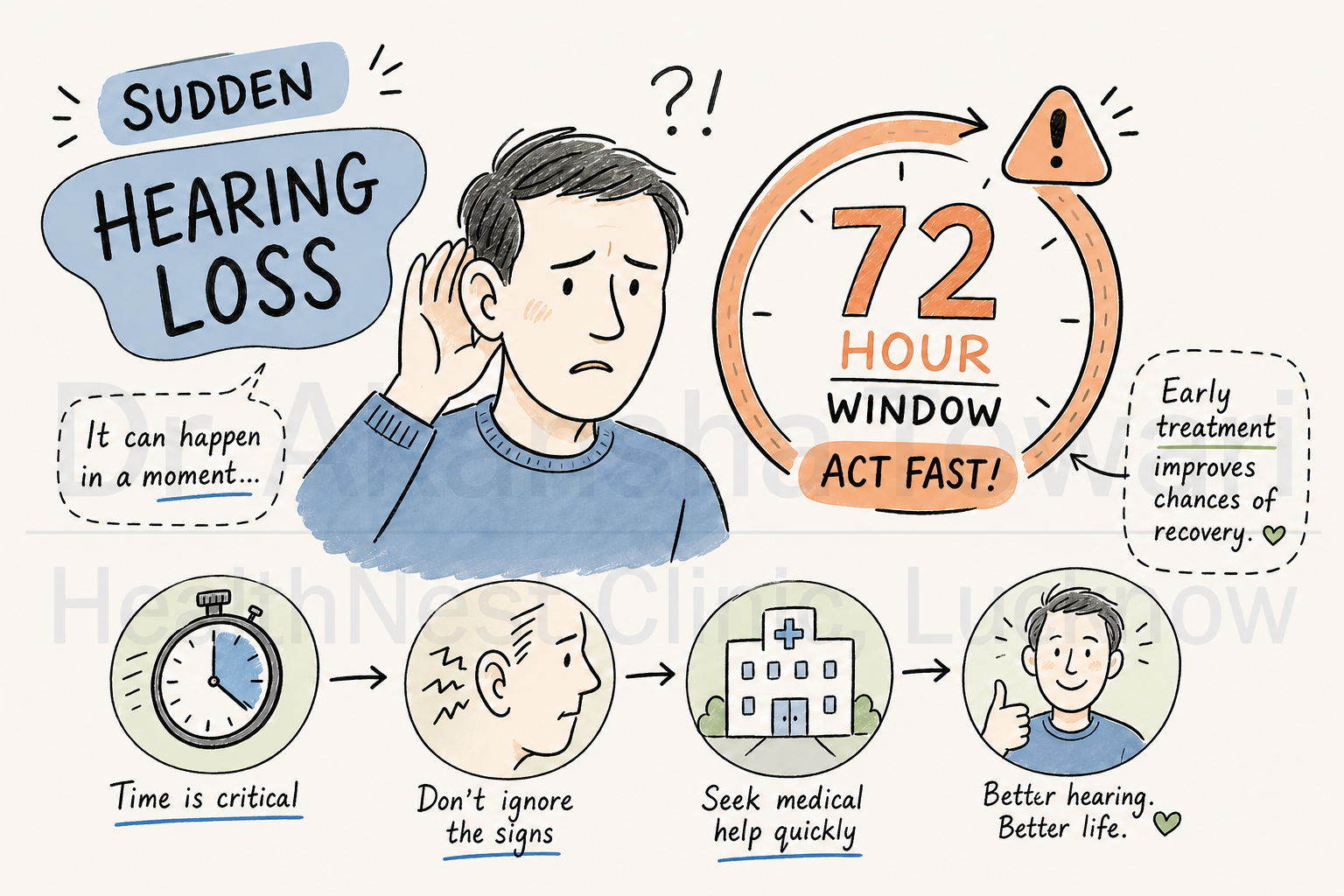
One ear suddenly feels silent or badly muffled? Seek care today.
Sudden hearing loss is easy to mistake for wax, a blocked Eustachian tube or the after-effects of a cold. Because an inner-ear loss cannot be identified reliably at home, the safest step is urgent medical assessment rather than self-treatment or a wait-and-see approach.
You may first notice the change when you wake up, answer a phone call or cover your better ear. There may be no pain and no warning. Tinnitus, ear fullness, dizziness or vertigo can occur at the same time.
The US National Institute on Deafness and Other Communication Disorders advises treating sudden deafness symptoms as a medical emergency and visiting a doctor immediately. The message is simple: do not lose valuable time trying ear-cleaning, steam inhalation or decongestants without an examination.
Important: the first 72 hours matter because they describe how rapidly the hearing loss develops and because earlier assessment protects treatment options. They are not a hard expiry time. If three days have already passed, seek care urgently anyway.
What sudden sensorineural hearing loss actually is
The classic definition
Sudden sensorineural hearing loss (SSNHL) is a rapid loss of inner-ear hearing. The classic audiological definition is a fall of at least 30 decibels across three consecutive frequencies occurring within 72 hours. People with a smaller but clearly sudden change can still need urgent evaluation, so do not use the number to rule yourself out.
SSNHL affects the cochlea or auditory pathway. This is different from conductive hearing loss, where wax, middle-ear fluid or an eardrum problem physically reduces the passage of sound. The symptoms can feel very similar, but the treatment is completely different.
Wax, fluid, infection or eardrum disease blocks sound before it reaches the inner ear. Examination and tympanometry can help identify the cause.
The ear canal may look normal, but audiometry shows reduced inner-ear hearing. This pattern needs an urgent treatment discussion.
How it commonly presents
- A sudden reduction in one ear, developing at once or over up to three days
- Words sounding distant, distorted or absent on one side
- New tinnitus: ringing, buzzing or hissing
- A blocked or full feeling despite little or no pain
- Dizziness, imbalance or vertigo in some patients
Sudden loss usually affects one ear. When both ears are involved, when episodes recur, or when there are neurological symptoms, the clinician will look especially carefully for an underlying cause.
Why urgent assessment matters
The inner ear is delicate, and clinicians cannot tell from symptoms alone whether the hearing change will recover. Some people improve spontaneously, often during the first one to two weeks, but waiting for that to happen can delay treatment that works best when started early.
The current AAO-HNSF sudden hearing loss guideline emphasises prompt recognition, audiometry as soon as possible and time from symptom onset when discussing treatment. It says clinicians may offer corticosteroids as initial therapy within two weeks of onset. Intratympanic steroid salvage treatment is recommended for incomplete recovery two to six weeks after onset.
That is why “72 hours” should motivate immediate action without creating false hopelessness. Today is better than tomorrow, but later is still better than never.
What can cause sudden hearing loss?
In more than 90% of SSNHL cases, no definite cause is found; these are called idiopathic. Treatment decisions should not wait for a perfect explanation. When the history points to a cause, the possibilities considered may include:
A recent infection or an inflammatory inner-ear process may be relevant, although a specific virus is rarely proven.
Small-vessel disease and cardiovascular risk may be considered, especially in older adults or when other neurological signs are present.
Autoimmune inner-ear disease is more likely to be considered with bilateral, fluctuating or recurrent hearing loss.
Certain chemotherapy medicines, aminoglycoside antibiotics and other ototoxic exposures may damage hearing. Never stop a prescribed medicine without medical advice.
An MRI of the internal auditory canals, or sometimes auditory brainstem response testing, is used to assess for causes such as vestibular schwannoma.
Head injury, blast exposure, diving or a sudden pressure change can cause acute hearing loss and needs urgent assessment.
Go to an emergency department now if hearing loss comes with:
- Facial weakness or drooping on one side
- Slurred speech, confusion, weakness or numbness on one side of the body
- A sudden severe headache, double vision or new inability to walk steadily
- Seizure or loss of consciousness
- Recent significant head injury or other signs of a neurological emergency
These features can indicate stroke or another central neurological problem. An outpatient ENT clinic cannot replace emergency imaging and neurological assessment. If no neurological red flag is present, arrange an urgent ENT assessment and hearing test.
What to do right now
Compare the ears once, without delaying
A phone call or softly rubbed fingers may make the asymmetry obvious. Do not repeatedly expose the ear to loud sounds or rely on an app to diagnose the problem.
Check for neurological red flags
If there is facial droop, one-sided weakness, slurred speech, severe sudden headache, double vision or inability to walk, go to an emergency department immediately.
Contact an ENT service urgently
Say clearly: “I have a sudden hearing loss in one ear that began at [time/date].” Ask for the earliest available examination and audiogram.
Avoid home ear treatments
Do not insert earbuds, pins, oil or unprescribed drops. Do not start steroids on your own; they have important contraindications and require clinician supervision.
Sudden hearing loss in one ear should be treated as urgent. HealthNest Clinic offers ENT evaluation and in-house audiometry in Golf City, Lucknow. Message the clinic with the exact onset time and any tinnitus, vertigo or neurological symptoms.
Request urgent assessmentTests your ENT may use
History and ear examination
The clinician asks when the loss began, whether it affects one or both ears, and whether there is tinnitus, vertigo, infection, trauma, noise exposure or a new medicine. Otoscopy checks for wax, fluid and eardrum disease.
Pure-tone audiometry
This is the key diagnostic test. It maps the degree and pattern of loss across frequencies and distinguishes sensorineural from conductive hearing loss. Guidelines recommend obtaining audiometry as soon as possible and within 14 days of onset.
Tympanometry and related hearing tests
Tympanometry assesses the eardrum and middle ear. Speech testing and tuning-fork findings add context to the audiogram.
MRI or auditory brainstem response
For confirmed SSNHL, retrocochlear assessment is recommended, usually with MRI of the internal auditory canals or sometimes auditory brainstem response testing.
Routine head CT and broad, untargeted blood-test panels are not recommended for every patient. Tests should follow the history and examination so that urgent treatment is not delayed by low-yield investigations.
Treatment: what the evidence supports
Initial corticosteroids
A clinician may offer systemic corticosteroids within two weeks of symptom onset after discussing expected benefits, limitations, risks and medical contraindications. The exact medicine, dose and taper must be prescribed for the individual patient.
Intratympanic steroids
Steroid is placed through the eardrum into the middle ear. This can be considered as initial treatment in selected patients and is recommended as salvage treatment when recovery remains incomplete two to six weeks after onset.
Hyperbaric oxygen in selected cases
Guidelines list hyperbaric oxygen combined with steroids as an option within two weeks for initial therapy or within one month as salvage therapy. Availability and suitability vary.
Follow-up audiometry
A repeat audiogram documents response. The guideline recommends hearing assessment at the end of treatment and again within six months after treatment is completed.
Do not self-prescribe steroids
Steroids can affect blood sugar, blood pressure, mood, sleep, infection risk and other conditions. Treatment requires a prescription and a risk assessment.
Avoid unsupported routine medicines
Guidelines recommend against routinely prescribing antivirals, thrombolytics, vasodilators or vasoactive substances for idiopathic SSNHL.
Recovery, prognosis and next steps
Recovery varies widely. Some people regain some or all hearing spontaneously, usually within the first one to two weeks. A milder initial loss, earlier improvement and absence of vertigo are generally associated with a more favourable average outcome; a profound initial loss and vertigo may indicate a less favourable prognosis.
No single factor can predict one person’s result with certainty. The practical response is the same for everyone: confirm the diagnosis quickly, complete treatment and follow-up, and repeat the audiogram.
If hearing does not fully return, the pathway continues. Intratympanic salvage treatment may still be appropriate within the guideline window. Persistent hearing loss should lead to counselling about hearing aids, tinnitus support and, for severe or profound loss, cochlear implant assessment when indicated.
Act today, even if 72 hours have passed
A sudden drop in hearing is not something to treat with rest, steam or ear-cleaning before anyone has examined the ear. The symptom may be caused by wax, but it may also be SSNHL, and that distinction needs an audiogram.
If you noticed a sudden change today, seek urgent assessment today. If the change began several days ago, do not assume that nothing can be done: guideline-backed initial and salvage treatment windows may still be open.
HealthNest Clinic provides specialist ENT consultation and in-house audiometry at Golf City, Lucknow. For sudden hearing loss, share the onset time in your message so the clinic can understand the urgency.
Message on WhatsAppFrequently asked questions
Is sudden hearing loss a medical emergency?
Yes. A sudden drop in hearing, especially in one ear, needs urgent medical assessment. An ear examination and audiogram help distinguish a blockage from SSNHL, for which early treatment may improve the chance of recovery.
Is 72 hours the only window for sudden hearing loss treatment?
No. The 72-hour period is part of the classic definition and highlights the urgency; it is not a hard treatment cutoff. Guidelines say corticosteroids may be offered as initial therapy within two weeks of symptom onset. Being assessed as early as possible protects the widest range of options.
How can I tell sudden sensorineural hearing loss from ear wax?
You cannot reliably tell at home. Wax and middle-ear fluid cause conductive loss, while SSNHL affects the inner ear. Otoscopy, tuning-fork assessment and pure-tone audiometry are used to distinguish them.
What test confirms sudden sensorineural hearing loss?
Pure-tone audiometry is the key test. It measures hearing thresholds across frequencies and shows whether the loss is sensorineural or conductive. Tympanometry may also be used to assess the eardrum and middle ear.
How is sudden sensorineural hearing loss treated?
Corticosteroids may be offered after an ENT clinician considers the timing, severity, medical history and contraindications. They may be given by mouth or by intratympanic injection. Intratympanic steroids are also recommended as salvage treatment for incomplete recovery two to six weeks after onset.
Can sudden hearing loss recover on its own?
Some people recover some or all hearing spontaneously, often within the first one to two weeks, but it is impossible to predict safely who will recover. Waiting for spontaneous improvement can delay time-sensitive assessment and treatment.
When should sudden hearing loss go to the emergency department?
Go immediately if hearing loss occurs with facial droop, weakness or numbness on one side, slurred speech, a severe sudden headache, double vision, inability to walk, seizure or loss of consciousness. These can indicate a neurological emergency such as stroke.
Should I still seek care if more than 72 hours have passed?
Yes. Do not assume it is too late. Initial steroid treatment may still be considered within two weeks, and salvage options may remain available later. Contact an ENT clinician as soon as possible.