

Every year, millions of people in India spend the changing seasons reaching for antihistamines, decongestants, and nasal sprays — often without a clear diagnosis. "It's probably sinusitis" and "I think I'm allergic to something" are said interchangeably in homes across the country, usually by people who have been treating themselves for years without lasting relief.
This is not just inconvenient. It matters clinically. Allergic rhinitis and sinusitis have overlapping symptoms, but they have different causes, different treatments, and very different long-term consequences if left unaddressed.
As someone who trained specifically in allergy and immunology after ENT, this is an area I care deeply about — because the number of patients I see who have been mismanaged for 5, 10, even 15 years before getting a proper diagnosis is genuinely troubling.
What Is Allergic Rhinitis?
Allergic rhinitis is an immune system response to a substance your body has mistakenly identified as a threat — a so-called allergen. Common culprits include dust mites, pollen, mould spores, pet dander, and certain foods.
When you breathe in an allergen, your immune system releases histamine, which triggers inflammation in the nasal lining. The result: sneezing, itching, watery discharge, and nasal congestion.
It can be seasonal (triggered by outdoor pollen during specific times of year) or perennial (year-round, usually due to indoor allergens like dust mites). In India, perennial allergic rhinitis is extremely common — the dust mite is present in bedding, carpets, and upholstery year-round in our climate.
What Is Sinusitis?
Sinusitis is inflammation of the sinuses — the air-filled cavities in the bones of the face and skull. It is most often triggered by a viral upper respiratory infection (the common cold), but can also follow an allergic reaction, a dental infection, or a structural nasal problem like a deviated septum.
Sinusitis can be acute (lasting under 4 weeks, usually following a cold), subacute (4–12 weeks), or chronic (persisting beyond 12 weeks). Chronic sinusitis is often the result of long-term, untreated allergic inflammation — which is why distinguishing the two matters so much.
How to Tell Them Apart
Here is a practical comparison to help you identify which you are more likely dealing with:
| Feature | Allergic Rhinitis | Sinusitis |
|---|---|---|
| Nasal discharge | Clear, watery, continuous | Thick, yellow-green, purulent |
| Sneezing | Frequent, in bursts, especially morning | Occasional |
| Itching | Eyes, nose, throat, roof of mouth | Absent or minimal |
| Facial pain/pressure | Usually absent | Common — cheeks, forehead, between eyes |
| Fever | None | May be present in acute sinusitis |
| Smell disturbance | Mild, due to blockage | Significant, persistent |
| Timing | Seasonal or on allergen exposure | After a cold or prolonged inflammation |
| Eye symptoms | Common — red, watery, itchy | Unusual |
| Duration | As long as exposure continues | Weeks; chronic if untreated |
| Response to antihistamines | Good, symptoms improve | Minimal or none |
The overlap that confuses everyone: Both conditions cause nasal blockage, postnasal drip, and a sense of facial fullness. And critically — long-standing allergic rhinitis frequently leads to sinusitis, because the swollen nasal lining blocks sinus drainage. You can have both simultaneously.
Why Untreated Allergy Is a Bigger Problem Than You Think
Allergy skin prick testing — available at HealthNest Clinic, Golf City, Lucknow at affordable pricing
The Numbers Tell a Sobering Story
Allergic rhinitis is one of the most underestimated chronic diseases in the world. Globally, it affects an estimated 10–25% of the population and is consistently listed among the top ten reasons people visit a primary care physician, according to published reviews in allergy and immunology journals.
In India, the picture is substantial. The Global Asthma Network Phase I study — the largest epidemiological survey of allergic disease in India, covering over 127,000 participants — found that approximately 9.8% of Indian adults and 23.5% of adolescents aged 13–14 years have allergic rhinitis. A large cross-sectional Indian study assessing patients with nasal symptoms found a prevalence of 53.7% — meaning more than half of people who walk into a clinic with nasal complaints have an underlying allergic basis that is often undiagnosed.
One of the most clinically significant findings from Indian research is the co-morbidity burden: approximately one in three patients with allergic rhinitis in India also has asthma. This is not coincidence — the same immunological pathway drives both conditions, a concept known as the "unified airway." Treating only the nose while ignoring the lower airway — or vice versa — consistently produces poor outcomes.
Despite this, the majority of patients with allergic rhinitis in India rely on home remedies or self-prescribed antihistamines and never receive a formal diagnosis or allergen-specific treatment. A community-based study from Delhi found that only 40% of rhinitis patients without asthma sought any medical treatment — and most who did received only symptomatic prescriptions.
This is the gap that concerns me most. The treatment that actually modifies the disease — allergen immunotherapy — remains largely inaccessible to most patients, either because it is not offered in their area or because the cost at corporate facilities makes it impractical. That is precisely why we have made it a priority at HealthNest Clinic.
This is the part most patients have never been told clearly — and it is the part that frustrates me most when I see patients years down the line.
Allergic rhinitis that is suppressed with antihistamines year after year — but never properly treated — does not stay the same. It progresses.
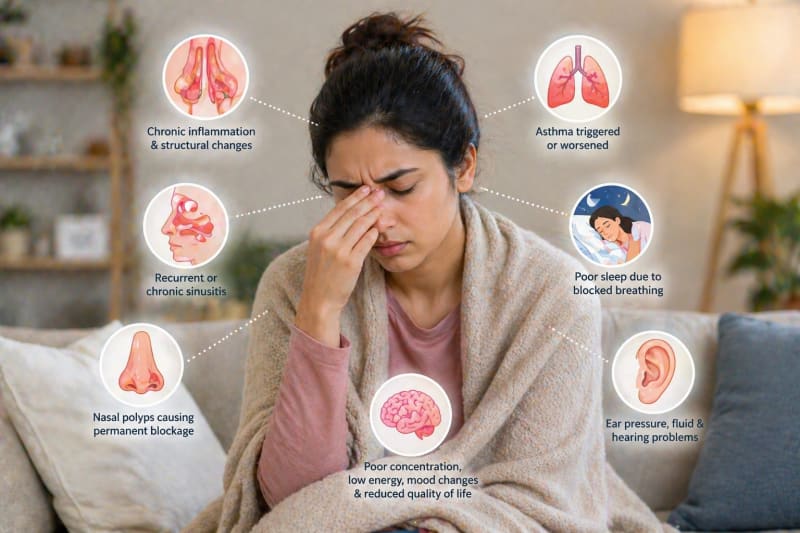
What happens when allergy goes untreated over years:
- Chronic inflammation of the nasal lining causes progressive thickening and structural changes
- Repeated sinus blockage leads to recurrent or chronic sinusitis
- Nasal polyps can develop — abnormal tissue growths that cause permanent blockage
- The same immune pathway that drives nasal allergy frequently triggers or worsens asthma
- Sleep quality deteriorates as nasal breathing becomes increasingly obstructed
- Eustachian tube dysfunction develops, leading to ear pressure, fluid, and hearing issues
- Quality of life — concentration, sleep, energy, mood — suffers significantly and silently
Antihistamines treat symptoms. They do nothing to modify the underlying immune response. Taking a cetirizine tablet every morning for ten years is not treatment — it is symptom suppression. And during those ten years, the disease is quietly doing damage.
The good news is that there is a treatment that actually addresses the root cause. It has been available for decades, is supported by excellent evidence, and is now accessible in Lucknow without needing to travel to a corporate hospital.
Have you been taking allergy medication for years without real relief? A skin prick test takes 30 minutes and changes everything. Book at HealthNest Clinic.
Book a Consultation →What Is a Skin Prick Test — and Why It Matters
A skin prick test (SPT) is the gold standard for identifying which specific allergens are triggering your immune system. It is simple, safe, takes about 30 minutes, and gives us precise, actionable information.
Here is how it works: small drops of common allergen extracts — dust mite, cockroach, mould, various tree and grass pollens, pet dander, and others — are placed on the forearm. A tiny prick through each drop introduces a trace amount under the skin. After 15–20 minutes, we measure any reactions. A raised, itchy wheal at a specific site confirms sensitivity to that allergen.
What a skin prick test tells us:
- Exactly which allergens are driving your symptoms
- Whether your allergy is dust-mite driven (perennial) or pollen-driven (seasonal)
- Whether you are sensitised to multiple allergens — which affects treatment planning
- Whether immunotherapy is appropriate and which allergen mix to use
- A baseline to measure treatment response over time
Without an SPT, allergy treatment is largely guesswork. You might be avoiding the wrong things, taking medication that does not match your specific trigger, and missing the opportunity for a permanent solution.
How Immunotherapy Works — and Why It Is the Only Permanent Option
Allergen immunotherapy (AIT) — also called allergy shots or allergy drops — is the only treatment that modifies the immune system's response to allergens rather than simply blocking symptoms.
Here is the principle: by introducing gradually increasing doses of the allergen your immune system is reacting to, we retrain it to tolerate that allergen rather than mount an inflammatory response. Over time, the immune system stops recognising the allergen as a threat. Symptoms reduce, and in many patients, disappear entirely.
It comes in two main forms:
Subcutaneous immunotherapy (SCIT) — injections given at the clinic, starting weekly and gradually spacing out to monthly over 3–5 years. This is the more established form with decades of research behind it.
Sublingual immunotherapy (SLIT) — allergen drops or tablets placed under the tongue at home, daily. Particularly convenient for patients who cannot visit frequently, including children.
The evidence is clear: Immunotherapy does not just suppress symptoms during treatment — it induces lasting immune tolerance. Studies consistently show that patients who complete a course of immunotherapy maintain their improvement for years after stopping treatment. No other allergy medication does this.
It is a commitment — typically 3 to 5 years — and it requires patience. But for anyone who has been suffering with allergy for years, the prospect of actually being free of it is worth taking seriously.
Skin Prick Testing and Immunotherapy at HealthNest Clinic, Lucknow
A facility most standalone clinics don't offer — at a price that corporates can't match
Allergy skin prick testing and immunotherapy have traditionally been available only at large corporate hospitals in Lucknow — where consultation fees, testing charges, and monthly injection costs make the treatment financially out of reach for most families.
At HealthNest Clinic, we offer the complete allergy workup and immunotherapy programme at a fraction of the cost — without compromising on the quality of allergen extracts, testing protocol, or clinical oversight.
Dr. Akansha Tewari completed her Fellowship in Asthma, Allergy & Immunology from AIIMS under the Global Allergy Program, Colorado USA — one of the most rigorous allergy training programmes available in India. The care you receive here is the same standard as a tier-1 hospital, in a clinic setting that is personal, accessible, and affordable.
- Complete allergy skin prick testing panel — dust mite, pollens, moulds, and more
- Personalised immunotherapy — subcutaneous and sublingual options available
- No referral needed — direct appointment
- Transparent, affordable pricing — ask us at the time of booking
- One of very few standalone ENT clinics in Lucknow offering this service
What Should You Do Next?
If you have had a blocked nose, sneezing, itchy eyes, or postnasal drip for more than a few weeks — especially if it comes and goes with seasons or happens every morning — there is a very good chance you have allergic rhinitis that has never been properly diagnosed.
If you have been taking antihistamines for years and feel like you are managing but not improving — that is a sign the underlying problem is not being addressed.
A single consultation at HealthNest Clinic includes a full clinical evaluation, a recommendation on whether skin prick testing is appropriate, and a clear explanation of your options. There is no obligation to proceed with immunotherapy at that point — but you will leave understanding your condition clearly, probably for the first time.
Bottom line: Allergic rhinitis and sinusitis are different. Allergy suppressed for years does permanent damage. A skin prick test tells you exactly what you are reacting to. And immunotherapy — when indicated — is the only treatment that can actually set you free from it. All of this is available at HealthNest Clinic, Golf City, Lucknow.
Common questions
How do I know if it is allergy or sinusitis?
Itchy sneezing, watery discharge and repeated triggers suggest allergy. Thick discharge, facial pressure, fever or symptoms worsening after a cold suggest sinusitis.
Can allergy turn into sinusitis?
Yes. Untreated nasal allergy can keep the nose blocked and inflamed, which makes sinus drainage poor and increases the chance of recurrent sinus infections.
Do antihistamines cure allergy permanently?
No. Antihistamines control symptoms while you take them. Long-term control needs trigger identification, nasal steroid sprays when indicated and sometimes immunotherapy.
When should I get allergy testing?
Consider testing if symptoms are recurrent, seasonal, triggered by dust or pets, need frequent medicines, or are associated with asthma, wheeze or sleep disturbance.
Can immunotherapy help sinus symptoms?
It can help when allergy is the driver behind repeated nasal swelling and blockage. It is not a shortcut for acute bacterial sinus infection.
When is sinusitis urgent?
Seek urgent care for swelling around the eye, severe headache, vision changes, high fever, neck stiffness, confusion or worsening symptoms despite treatment.