"Doctor, kya allergy ka permanent ilaj hai?"
The honest answer: no one can guarantee you a cure — and anyone who does is selling, not treating.
What medicine can offer is this: one treatment — allergen immunotherapy, the "allergy vaccine" — retrains your immune system instead of silencing your symptoms every 24 hours. It takes commitment. It doesn't suit everyone. And it is the only treatment shown to keep working after you stop taking it.
Antihistamines are umbrellas.
They keep you dry while it rains — they do not stop the rain. If you have refilled the same tablet for years, your allergy has not been treated once. It has been postponed daily.
A mail-order panel is not a diagnosis.
Home-collection reports routinely return dozens of "positives" that have nothing to do with your symptoms. A positive test means your blood recognises a substance — not that it is making you sick.
"Guaranteed cure" is a warning sign.
Registered medical practice prohibits promising cures — because biology doesn't sign guarantees. Wherever you see one, you have left medicine and entered marketing.
Every allergy treatment in the world does one of two things.
It either suppresses your reaction, or it retrains the system that produces the reaction. Both have their place. Only one changes your future.
Antihistamines, nasal sprays, montelukast
- What it does: blocks the chemical cascade after the allergic reaction has already fired
- How fast: works within hours — genuinely useful for flare-ups and season peaks
- How long it lasts: exactly as long as the medicine is in your body
- Your immune system after 5 years: unchanged — reacts exactly as it did on day one
Necessary. Effective. Endless.
Allergen immunotherapy — the "allergy vaccine"
- What it does: teaches your immune system to tolerate the specific allergens you actually react to
- How fast: meaningful relief typically builds over 6–12 months
- How long it lasts: benefit is designed to persist after the course ends
- Your immune system after a full course: measurably different — that is the entire point
Slow. Demanding. The only exit.
This is not a case against symptom medicines — we prescribe them, and during immunotherapy you may still need them at first. It is a case against only ever taking them, year after year, without anyone offering you the treatment that could reduce your need for them.
How immunotherapy actually works here
History first
What triggers you, when, where, and what you've already tried. Testing without this is guesswork with a price tag.
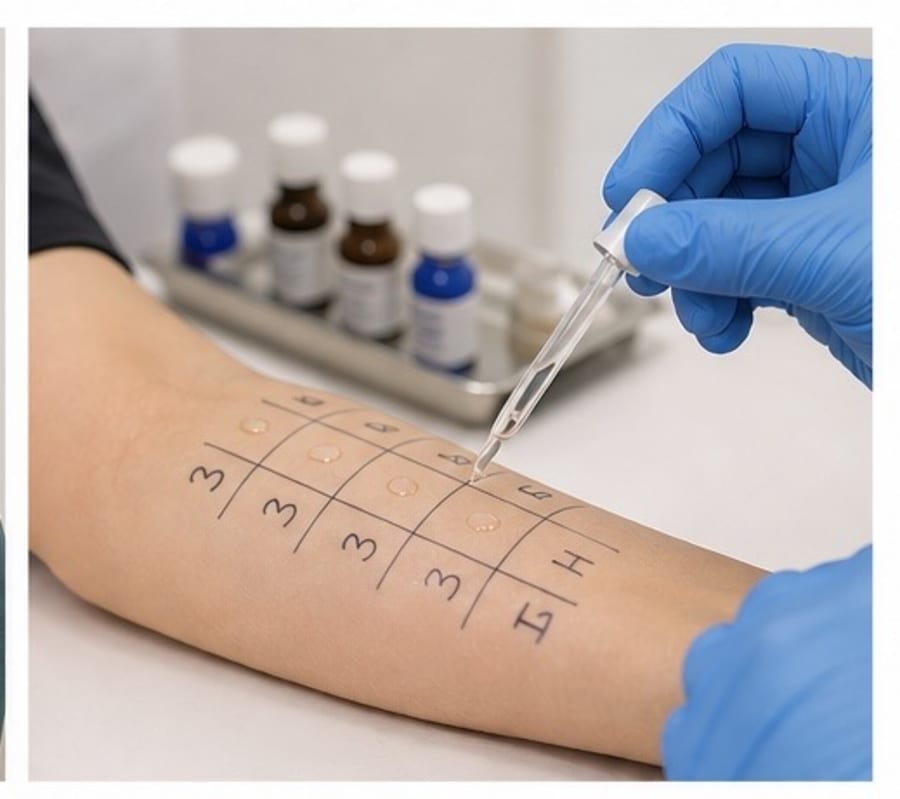
Skin prick test
Performed and read in-clinic by Dr. Tewari — results in about 20 minutes, correlated against your story, not just printed.
The honest verdict
Whether immunotherapy will genuinely help you — or whether avoidance and symptom control are the smarter plan. Both answers are given freely.
Supervised first dose
Your personalised sublingual drops begin in clinic, under observation. After that, one daily dose at home, under the tongue.
Follow-up that continues
Scheduled reviews track your response over the full course — because a 3-year treatment without follow-up is just a subscription.
Drops, not weekly injections. Home dosing, not clinic queues. A programme, not a package.
What immunotherapy cannot do — and who should not start it.
A treatment this good deserves honest limits, stated upfront:
- It treats airborne allergies — dust mite, pollens, moulds, animal dander — driving allergic rhinitis and allergic asthma. It is not a cure for food allergy or drug allergy.
- It is a 3-to-5-year commitment of daily doses. Stopping at 8 months because you feel better is the most common way patients waste their own progress.
- It is not started during uncontrolled severe asthma, and some medical conditions rule it out — that is exactly what the first consultation screens for.
- Improvement is probable, not promised. Most patients respond well; a minority respond partially. Anyone quoting you a success percentage before examining you is quoting an advertisement.
If you are not a candidate, you will hear it at visit one — along with what to do instead. Learn more about how allergy testing works at HealthNest.
A ₹699 panel with 40 positives is not 40 allergies.
Direct-to-consumer allergy panels — home collection, no doctor, results by email — have created a new kind of patient in Lucknow: perfectly healthy people terrified of their own blood report, and genuinely allergic people no closer to knowing what to do.
Two words explain why:
Sensitisation
Your blood recognises a substance and flags it on a lab report. Extremely common, frequently harmless, and the only thing a standalone panel can show.
Clinical allergy
That substance actually produces your symptoms in real life. This diagnosis can only be made by matching test results against your history — a doctor's job, not a courier's.
And the "food intolerance" IgG panels sold with 200+ parameters? They have no accepted scientific basis for diagnosing allergy at all. If you already have a panel report — from any lab — bring it. Reading it properly is often the most useful thing your first visit does.
Dr. Akansha Tewari
MS ENT (KGMU) · DNB ORL · Fellowship in Allergy, Asthma & Immunology (AIIMS, New Delhi)
Allergic rhinitis, allergic asthma and sinus disease live in ENT territory — which is why an ENT surgeon with formal AIIMS training in allergy and immunology runs this programme end to end: the testing, the interpretation, the immunotherapy formulation, and every follow-up. The person who pricks your skin is the person who reads it, and the person who reads it is the person who treats you.
Questions patients actually ask
Kya allergy ka permanent ilaj hai? Honestly?
What exactly is the "allergy vaccine"?
Drops or injections — which is better?
How soon will I feel better, and when can I stop my current medicines?
Is it safe for my child?
What does the programme cost?
You've suppressed it for years.
Come find out if it can be retrained.
Bring your old reports, your current medicines, and every question. Worst case, you leave knowing exactly where you stand — which is more than a refill gives you.