

As a parent, you know when something is not right with your child. You notice the subtle things — the way they tilt their head to hear you, the nights they sleep with their mouth hanging open, the ear they keep touching during a meal. But knowing when to act on those observations is not always obvious.
Primary care doctors do an excellent job of managing common childhood illnesses. But there are specific situations where a child genuinely needs the expertise of an ENT specialist — someone trained to look deeper, diagnose accurately, and offer treatment beyond a course of antibiotics.
This guide will help you understand those situations clearly. No alarm, no unnecessary worry — just honest clinical guidance.
1. Ear Problems That Keep Coming Back
A single ear infection is common, especially in children under five. Their Eustachian tubes — the canals that connect the middle ear to the back of the throat — are shorter and more horizontal than in adults, making it easier for bacteria to travel upward from the throat.
But when ear infections keep coming back, something else is usually going on.
See an ENT if your child has:
- Three or more ear infections in six months
- Four or more in a single year
- Fluid behind the eardrum persisting for more than three months
- Ear pain or discharge that does not resolve with treatment
- Any hearing concern following repeated infections
Repeated infections can lead to a condition called otitis media with effusion — commonly known as "glue ear" — where thick, sticky fluid accumulates in the middle ear and muffles sound. In young children, this can quietly affect speech development and learning without anyone realising the root cause.
A note from the clinic: Many families come to us after months of repeated courses of antibiotics. The child is fine during treatment, then sick again a month later. At that point, the question is not which antibiotic to use — it is why the infections keep happening. That is an ENT question.
2. Any Concern About Your Child's Hearing
Hearing is foundational to everything else — language, learning, social connection, and confidence. A child who cannot hear well will often be misidentified as inattentive, slow, or difficult, when the real problem is that they simply cannot hear clearly.
Parents are often the first to notice. Trust that instinct.
Bring your child for a hearing evaluation if:
- They do not turn toward sound consistently by 6 months of age
- They are not saying single words by 12–15 months
- Their speech seems unclear or delayed for their age
- They frequently ask "what?" or turn the TV up very loud
- Teachers have raised concerns about listening in class
- They seem to hear better on one side than the other
- They failed a school hearing screening
At HealthNest Clinic, we perform pure tone audiometry and tympanometry — simple, painless tests that give us a precise picture of how well your child hears and whether there is fluid or pressure affecting the middle ear. The test takes about 15 minutes and requires no preparation.
Concerned about your child's hearing or recurring ear infections? A single clinic visit gives you answers — not more waiting.
Book an Appointment →3. Snoring, Mouth Breathing, or Noisy Sleep
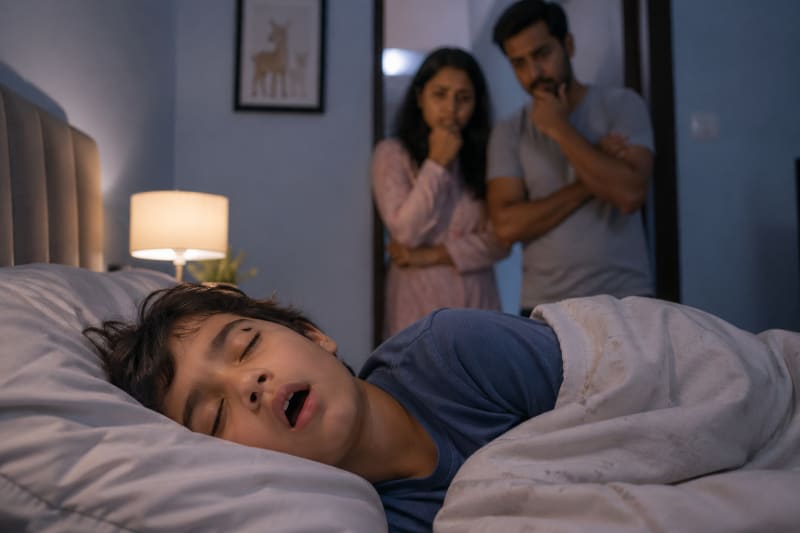
Children should breathe quietly through their nose, even during sleep. If your child snores regularly, sleeps with their mouth open, or makes a gasping or choking sound at night — this is not something to simply wait out.
The most common cause in children is enlarged adenoids or tonsils, which partially block the airway during sleep. In more significant cases, this becomes obstructive sleep apnoea — where the child's breathing repeatedly pauses during the night, interrupting deep sleep and depriving the brain of oxygen.
Children with poor sleep due to airway obstruction often show up as hyperactive, unfocused, or emotionally volatile during the day. It is not a behaviour issue. It is a sleep issue — and often, an ENT issue.
Do not wait if: your child pauses breathing during sleep, gasps or chokes at night, wakes frequently, or sweats heavily during sleep. These are signs of obstructive sleep apnoea and need prompt evaluation.
4. Persistent Nasal Blockage, Nosebleeds, or Throat Problems
A blocked nose that lasts beyond a cold, recurring nosebleeds without obvious cause, or a child who is constantly clearing their throat — these are not emergencies, but they are signs that something needs a closer look.
Consider an ENT visit for:
- Nasal congestion lasting more than 3 weeks without a cold
- Nosebleeds occurring more than once a week
- Nasal polyps or a previously diagnosed deviated septum
- Chronic throat clearing, voice hoarseness, or throat pain beyond two weeks
- Difficulty swallowing solids or liquids
- A neck lump that has been present for more than 2–3 weeks
Many children with persistent nasal symptoms actually have an underlying allergic rhinitis — year-round or seasonal — that has never been properly diagnosed. At HealthNest, we can evaluate this with a simple skin prick test and offer a management plan that goes well beyond an antihistamine prescription.
5. Recurrent Tonsillitis or Throat Infections

Most children get a sore throat now and then. But when tonsillitis is happening repeatedly — causing your child to miss school, suffer high fevers, and go through multiple rounds of antibiotics — it is time to discuss whether the tonsils are doing more harm than good.
Refer to ENT if your child has:
- Seven or more episodes of tonsillitis in one year
- Five or more episodes per year for two consecutive years
- Three or more episodes per year for three consecutive years
- A peritonsillar abscess (abscess around the tonsil)
- Tonsils so large they affect eating or breathing
Surgery is not always the answer — but sometimes it genuinely is. A tonsillectomy, when indicated, is one of the most effective and well-studied procedures in paediatric ENT. The decision is never taken lightly, and we will always explain our clinical reasoning in full before recommending anything.
Situations That Need Urgent ENT Opinion
The following are not conditions to manage at home or wait out with a GP appointment. If your child has any of these, seek same-day or emergency ENT evaluation immediately.
Go to emergency care or contact an ENT urgently if your child has:
- Noisy breathing (stridor) in a newborn or infant — high-pitched sound during breathing that was not present at birth, or worsens over days
- Suspected foreign body in the ear or nose — especially a button battery, which causes irreversible tissue damage within hours
- Suspected swallowed foreign body — coins, button batteries, toys, or sharp objects; if the child is drooling, refusing food, or has neck pain
- Sudden complete hearing loss in one ear — this is a medical emergency with a narrow treatment window
- Rapidly worsening sore throat with inability to open mouth fully — may indicate a peritonsillar abscess requiring urgent drainage
- Facial or neck swelling spreading rapidly — especially if the child has fever, difficulty swallowing, or the swelling is crossing the midline
- Deep neck abscess or Ludwig's angina — floor-of-mouth swelling, raised tongue, muffled voice, inability to swallow saliva
- Nosebleed that has not stopped after 20 minutes of sustained pressure
- Post-tonsillectomy bleeding — any bleeding from the throat after a tonsil surgery, even if it appears to stop
- Sudden voice loss with difficulty breathing — may indicate laryngeal or supraglottic pathology
- Mastoiditis — ear infection with ear pushed forward, swelling behind the ear, and high fever; this needs immediate intervention
- Acute facial nerve palsy — sudden drooping of one side of the face in a child with ear pain or recent ear infection
- Trauma to the ear, nose, or throat — suspected cartilage injury, septal haematoma, or tympanic membrane perforation from a slap or blast
Stay tuned. Each of these conditions deserves its own detailed discussion — from how to recognise them at home to what happens at the hospital. We will be covering them one by one in upcoming HealthNest blog posts. Follow HealthDigest on WhatsApp to get notified when each post goes live.
What Happens at a Pediatric ENT Visit
Many parents hesitate because they are unsure what the visit will involve. Here is exactly what to expect at HealthNest Clinic:
A typical first visit includes:
- A detailed history — your child's symptoms, duration, pattern, and past treatments
- Examination of the ears using an otoscope or microscope
- Examination of the nose and throat using a headlight and small mirror or endoscope
- Hearing test if clinically indicated (takes 10–15 minutes)
- A clear explanation of our findings and a practical management plan
- No unnecessary investigations or referrals
We see patients of all ages — including infants. If your child is anxious, please let us know in advance. We are experienced in making young children feel comfortable, and we always explain what we are doing before we do it.
Appointments are available Monday to Saturday, 5:30 PM to 8:30 PM, and Sunday mornings from 10:00 AM to 1:00 PM at HealthNest Clinic, Golf City, Lucknow.
Bottom line: If something about your child's ears, hearing, nose, throat, or sleep has been bothering you for more than a few weeks — you are probably right to be concerned. One visit is all it takes to know whether there is something to treat, or to have the peace of mind that everything is fine.
Common questions
How many ear infections are too many?
Three or more infections in six months, or four in a year, should prompt an ENT review, especially if hearing, school or sleep is affected.
Does snoring always mean adenoid problems?
No, but regular snoring, mouth breathing, gasping or restless sleep often points to adenoids, tonsils or nasal allergy and deserves evaluation.
When should my child get a hearing test?
Book a hearing test for delayed speech, poor school attention, repeated ear infections, loud TV volume, or if the child often asks you to repeat.
Are ENT examinations painful for children?
Routine ear, nose and throat examination is usually quick and not painful. If endoscopy or cleaning is needed, the doctor explains it first.
Can allergy cause repeated ear or nose problems?
Yes. Allergic rhinitis can block the nose and Eustachian tube, contributing to mouth breathing, snoring, ear fullness and middle-ear fluid.
When is a child ENT problem urgent?
Urgent signs include noisy breathing, button battery in the nose or ear, sudden hearing loss, severe throat swelling, uncontrolled nosebleed or post-tonsillectomy bleeding.