“Chakkar kyun aa raha hai—and VNG se kya pata chalega?”
VNG can add objective information about the eye-movement and balance pathways. It does not, by itself, name the cause of every dizzy spell. The useful question is whether the test can answer a specific clinical uncertainty in your case.
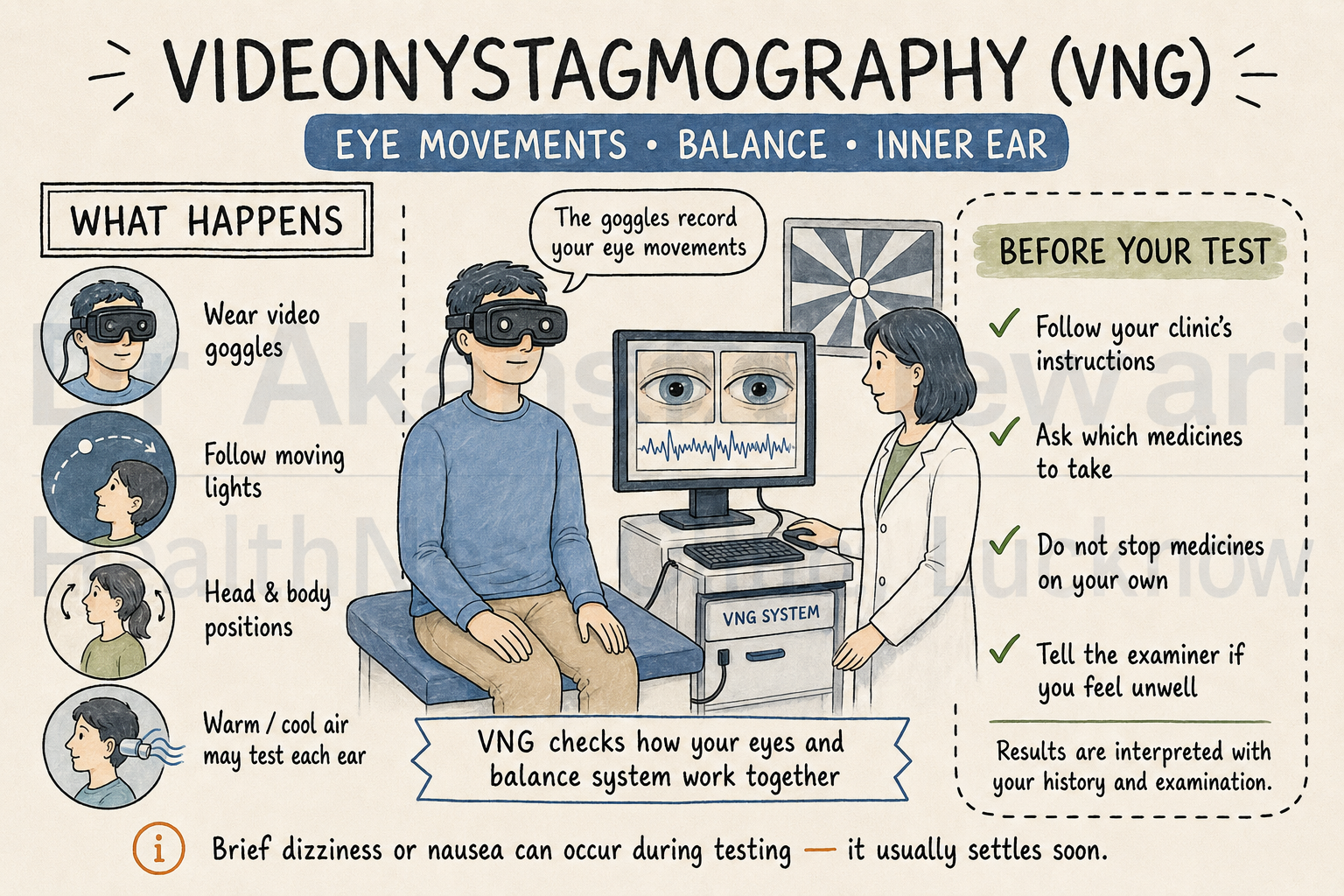
Being referred for a videonystagmography test can sound more intimidating than the test itself. VNG is a non-invasive assessment that uses infrared cameras in a pair of goggles to record eye movements. Those movements offer indirect information about the vestibular system—the inner-ear and brain pathways involved in balance and stable vision.
The assessment is not automatically required for every person with vertigo (chakkar). A clinician first uses the timing, triggers and accompanying symptoms, together with an eye, ear, neurological and balance examination, to decide whether VNG is likely to change the next step.
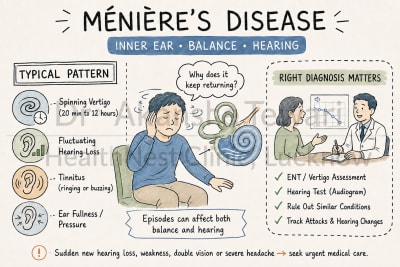
Key limitation: VNG can show patterns that support vestibular asymmetry, positional nystagmus or possible central involvement. It cannot independently confirm Ménière's disease, vestibular migraine, vestibular neuritis, labyrinthitis or an acoustic neuroma.
What VNG actually measures
Your inner ears, eyes and brain continuously coordinate through the vestibulo-ocular reflex (VOR). When your head moves, the VOR moves the eyes in the opposite direction so the scene stays clear. Disorders affecting the balance system can alter this response or produce nystagmus—involuntary eye movement with recognisable direction and timing.
VNG can record the eyes in darkness or with vision removed, reducing the brain's ability to suppress some vestibular nystagmus with visual fixation. The clinician then considers the recording together with age, vision, attention, medicines, test technique and the clinical examination.
Tracking and target-jump tasks assess how the eyes follow, shift and hold gaze. Abnormal results may reflect neurological, visual, medication-related or attention-related factors and require clinical correlation.
Goggles can document nystagmus during positional manoeuvres, including patterns compatible with BPPV when the history and movement response agree.
Warm and cool stimulation tests each labyrinth separately at a low frequency. The comparison may reveal asymmetry, but it does not identify the cause on its own.
Recording with and without visual fixation can add information about how nystagmus changes. No single sign should be interpreted outside the full test and examination.
When can VNG be useful?
VNG is most useful when it has a defined clinical purpose. Examples include persistent or recurrent dizziness with an unclear pattern, suspected vestibular asymmetry, subtle or atypical positional nystagmus, unexplained imbalance, or monitoring when objective vestibular information would affect rehabilitation or further investigation.
It may help localise dysfunction
Some test patterns support a peripheral vestibular problem; others raise concern about oculomotor or central pathways. Both categories need interpretation in context.
It is not always the first test
Classic BPPV can often be diagnosed with a bedside Dix-Hallpike or supine roll test. Guidelines discourage unnecessary vestibular testing when the BPPV criteria are already met and no inconsistent feature is present.
It does not replace hearing tests or MRI
Audiometry answers hearing questions. MRI may be selected for asymmetric hearing loss or another neurological concern. VNG cannot confirm or exclude a tumour.
It is not an emergency stroke screen
New facial droop, speech difficulty, one-sided weakness, double vision, severe headache or inability to stand needs urgent medical assessment—not a routine outpatient VNG booking.
What happens during the test?
The exact battery varies. Not every person needs every component, and caloric testing is not included in all VNG protocols. Your clinician should select the components that answer the referral question.
History, ear check and goggle setup
The tester reviews symptoms and medicines, checks for factors that may change or limit testing, and positions the video goggles so each eye can be tracked accurately. Earwax, ear infection, eardrum status and previous ear surgery matter if caloric testing is planned.
Oculomotor testing
You may follow a moving target, look between targets or hold your gaze in different directions. The system measures smooth pursuit, saccades, gaze holding and sometimes optokinetic responses.
Positional and positioning tests
Your head and body are moved through selected positions while the goggles record eye movements. A Dix-Hallpike or supine roll test may be performed when BPPV is suspected. Tell the tester about neck, back or vascular restrictions before these manoeuvres.
Caloric testing, when indicated
Warm and cool air or water is delivered according to the laboratory protocol while you lie back. Brief vertigo and nystagmus are expected responses. Each ear is assessed separately, allowing the responses to be compared.
Recovery and interpretation
Symptoms usually settle after the provoking part stops, but some people remain temporarily unsteady or nauseated. The clinician reviews recording quality and interprets the pattern with the history and examination rather than reading one number in isolation.
How to prepare safely
Preparation matters because medicines, alcohol, vision, alertness and food intake can affect comfort or interpretation. However, a blanket “stop everything for 48 hours” rule is not clinically safe or scientifically appropriate for every medicine.
Include anti-vertigo, anti-nausea, allergy, sleep, anxiety, pain, seizure and psychiatric medicines, as well as supplements. Ask for written, medicine-specific instructions.
Some medicines should not be stopped abruptly, and continued use may be safer even if it affects the tracing. The lab can document what was taken and interpret accordingly.
Many centres prefer a light meal to reduce nausea, while individual protocols differ on caffeine, alcohol and fasting. Follow the instructions from the centre performing your test.
Avoid eye makeup and heavy face products around the goggle seal. Bring your glasses and ask the centre whether contact lenses should be removed for its equipment.
- Wear comfortable clothing and tell the tester if lying back or turning your head is difficult.
- Bring previous hearing, imaging and vestibular reports if available.
- Tell the clinic if you have an active ear infection, a perforated eardrum, ventilation tubes, ear surgery, severe visual impairment, pregnancy or a medical condition affected by fluid or air stimulation.
- Consider arranging transport. Do not drive until any provoked dizziness has fully settled and you feel safe.
If you have a VNG appointment, send the clinic your current medication list and ear-surgery history before the test so preparation can be individualised safely.
Ask about preparationSafety, discomfort and when testing changes
VNG is non-invasive and is not usually painful. Because the purpose is to observe the balance system, positional and caloric components can deliberately reproduce vertigo, nausea, sweating or unsteadiness for a short time. The tester should explain this, monitor you and pause or modify the assessment when needed.
Eardrum perforation or tube
Open-loop water irrigation is contraindicated when the eardrum is perforated or a pressure-equalisation tube is present. The clinician decides whether an alternative stimulus, a modified protocol or omission is appropriate.
Blocked or painful ear
Wax obstructing the canal can invalidate or prevent caloric testing. Active infection or significant ear pain needs assessment before proceeding.
Previous ear surgery
Altered ear anatomy can change the safety and meaning of caloric responses. Give the testing team the operation details wherever possible.
Movement limitations
Neck, back, vascular or mobility concerns may require slower or modified positioning. Do not push through a manoeuvre that feels unsafe.
Understanding your VNG report
A report should describe which components were completed, recording quality, medications or limitations that may have affected the result, and the observed pattern. The conclusion should be connected to the original clinical question.
A peripheral-appearing pattern
Examples include nystagmus that matches a recognised BPPV canal pattern or a caloric response that is lower on one side. Such findings support a peripheral vestibular explanation, but the VNG does not establish whether caloric asymmetry comes from vestibular neuritis, Ménière's disease, a longstanding deficit or another cause.
A central-appearing or oculomotor abnormality
Abnormal saccades, pursuit, gaze holding or certain nystagmus patterns can raise concern about central pathways. They are not automatically proof of a brain lesion. Visual acuity, age, fatigue, attention, medicines and recording artefact can contribute. The clinician decides whether neurological examination, repeat testing or imaging is appropriate.
A normal or inconclusive result
A normal VNG does not mean the symptoms are imaginary. It does not exclude vestibular migraine, persistent postural-perceptual dizziness (PPPD), intermittent BPPV that was inactive during testing, or dysfunction outside the pathways and frequencies tested. An inconclusive result may reflect poor camera tracking, intolerance or an incomplete battery.
Ask at the review: What clinical question did the test answer? Which findings are reliable? Do they fit my symptoms? What remains uncertain? Will the result change treatment, rehabilitation or the need for another test?
How VNG compares with other tests
| Assessment | Main question | What it cannot do alone |
|---|---|---|
| VNG | Records eye movements during oculomotor, positional and/or caloric testing. | Cannot name every cause of dizziness or replace clinical interpretation. |
| Dix-Hallpike / roll test | Looks for canal-specific positional vertigo at the bedside. | Does not assess the full oculomotor or caloric battery. |
| vHIT | Assesses high-frequency VOR function across semicircular canals during rapid, small head impulses. | Does not simply replace caloric testing; the tests stimulate different frequency ranges. |
| Audiometry | Measures hearing thresholds and speech understanding. | Does not directly measure vestibular eye-movement responses. |
| MRI | Images selected brain, nerve or inner-ear anatomy. | Does not replace functional vestibular testing and is not required for every dizzy patient. |
| ENG | Uses surface electrodes to record electrical changes related to eye movement. | Does not record torsional eye movement as video can; it may still be useful when video tracking is unsuitable. |
Choosing a testing centre
Equipment alone does not make a useful vestibular assessment. Look for a centre that starts with a clinical evaluation, gives individual preparation instructions, checks ear and movement safety, documents test limitations, and explains how the findings fit your symptoms. Ask which components are included and whether a specialist review of the report is part of the service.
Fees vary by the selected test battery and whether consultation or other investigations are included. Confirm the current fee directly with the centre rather than relying on an online price range.
Do not wait for routine VNG if dizziness occurs with:
- Facial droop, slurred speech, one-sided weakness or numbness
- Double vision, a severe new headache, confusion or loss of consciousness
- New inability to stand or walk, especially when unlike previous episodes
- Chest pain, serious injury or a sudden collapse
- Sudden hearing loss, which needs urgent same-day assessment through a separate time-sensitive pathway
The bottom line
VNG is a structured way to record eye movements and examine selected balance pathways. Its value comes from answering a focused question—not from generating a label in isolation. Preparation should be individualised, the test may briefly provoke dizziness, and ear or movement limitations may change the protocol.
The most useful result is one interpreted by a clinician who can connect the recording with your episode pattern, hearing, examination and any other selected tests. That is what turns vestibular data into a safe next step.
HealthNest Clinic provides specialist vertigo assessment, audiometry and VNG when clinically indicated at Golf City, Lucknow.
Message on WhatsAppFrequently asked questions
Kya har baar chakkar aane par VNG test zaroori hota hai?
No. VNG is ordered when the history and examination leave a question that vestibular testing can help answer. Classic BPPV can often be diagnosed with a bedside positional test, while a new neurological deficit needs emergency assessment rather than a routine VNG appointment.
What does a VNG test measure?
VNG uses infrared cameras to record involuntary and task-related eye movements. Depending on the test battery, it can assess oculomotor pathways, position-related nystagmus and the response of each inner ear to caloric stimulation.
Is a VNG test painful?
VNG is non-invasive and is not usually painful. Positional or caloric testing may temporarily provoke dizziness, nausea or unsteadiness. Tell the clinician if symptoms are intense because the test can be paused or modified.
How long does a VNG test take?
Appointment length varies with the questions being investigated, the components included and how well testing is tolerated. Ask the testing centre for the time reserved for your individual protocol rather than relying on a fixed duration.
Do I need to stop medicines before VNG?
There is no universal medication washout that is right for every patient or medicine. Give the clinic a complete medication list and follow its individual written instructions. Never stop a prescribed medicine independently, especially one with withdrawal risk or one needed for safety.
Can I eat or drink before VNG?
Follow the testing centre's instructions. Many centres advise a light meal rather than a heavy meal, but fasting and restrictions on caffeine, alcohol or other substances vary with the protocol and the patient's medical needs.
Can VNG diagnose BPPV?
VNG goggles can document the nystagmus triggered during positional testing and help when movements are subtle or fixation needs to be removed. Many people with typical BPPV can still be diagnosed at the bedside without a full laboratory VNG battery.
What does unilateral caloric weakness mean?
It means the caloric response is lower on one side than the other according to the laboratory's criteria. It supports vestibular asymmetry at the low-frequency range tested, but it does not by itself prove the cause, exact site or age of the problem.
What if my VNG result is normal?
A normal VNG does not mean the symptoms are imaginary and does not exclude every balance disorder. Vestibular migraine, persistent postural-perceptual dizziness, intermittent BPPV and conditions outside the tested pathways may still need consideration.
Can I drive after a VNG test?
Some people feel temporarily dizzy or unsteady after testing. Ask the clinic about its policy, consider arranging transport and do not drive until you feel fully recovered and safe. Sedating medicines may add further restrictions.
Clinical sources
- American Speech-Language-Hearing Association: Balance System Disorders—Assessment
- MedlinePlus: Videonystagmography (VNG)
- American Academy of Audiology: Medication discontinuation before vestibular testing
- AAO-HNSF Clinical Practice Guideline: Benign Paroxysmal Positional Vertigo
- Systematic review and meta-analysis: vHIT and caloric testing in chronic dizziness
- NCBI Bookshelf/PubMed: Caloric Testing