
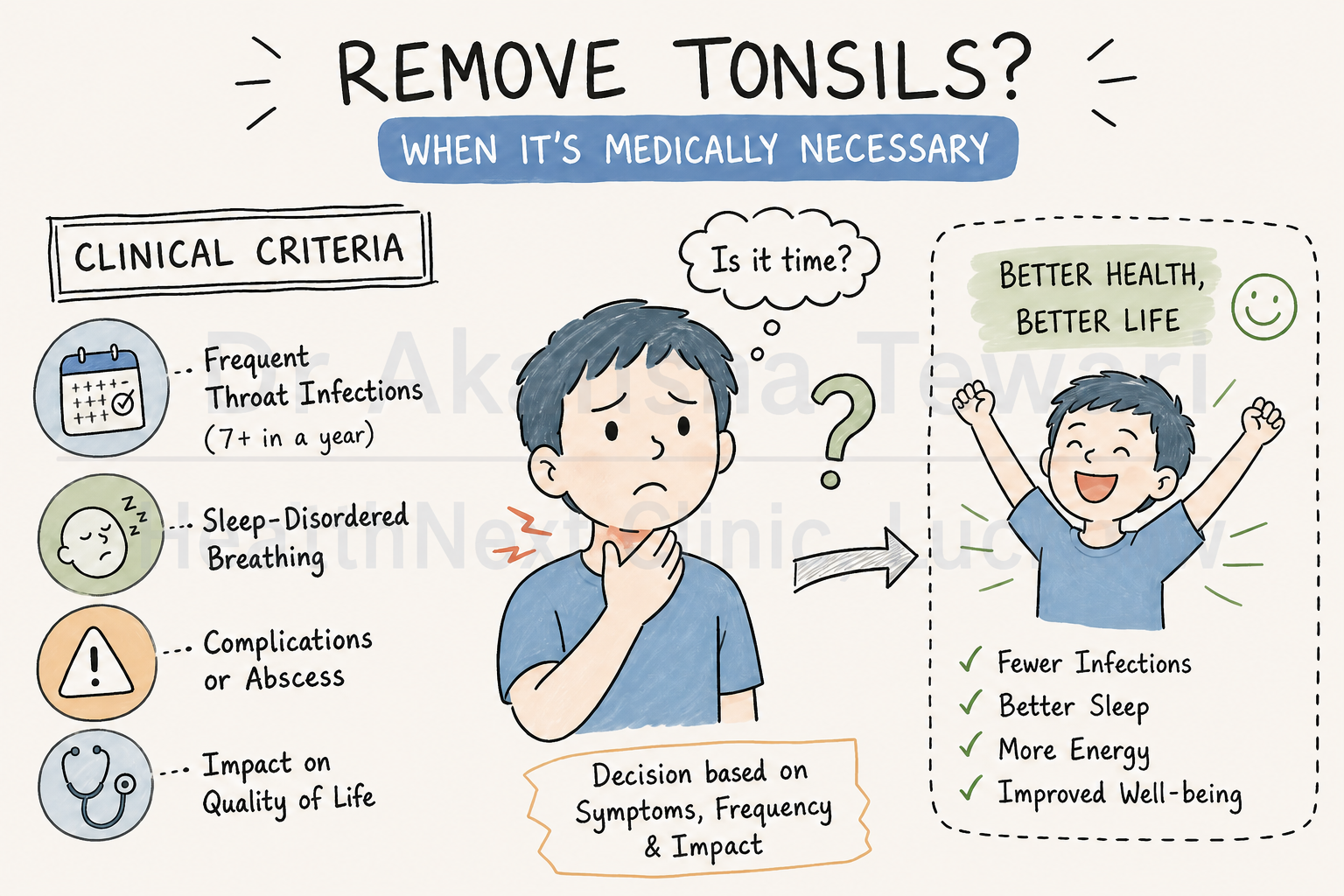
The right question is not just “How often does the throat hurt?”
An ENT assessment asks whether the episodes are truly acute tonsillitis, how well they were documented, whether they disrupt school or work, and whether enlarged tonsils are affecting breathing, sleep or swallowing. Surgery is considered when the likely benefit outweighs the pain, bleeding risk and recovery burden.
Tonsils are part of the immune tissue at the back of the throat. They can become repeatedly infected or grow large enough to narrow the airway. Removing them can reduce future episodes in appropriately selected patients, but it does not prevent every type of sore throat.
This guide explains the usual clinical framework for children and adults. It is a starting point for an ENT conversation, not a self-diagnosis or an automatic instruction to have surgery.
Core principle: the familiar 7/5/3 numbers are only one part of the decision. Episodes should be caused by acute tonsillitis, be documented and disabling, and be weighed against the risks and recovery from surgery.
The 7/5/3 criteria for recurrent tonsillitis
Guidelines commonly use the following frequency thresholds when considering tonsillectomy for recurrent acute tonsillitis:
At least seven qualifying episodes of acute tonsillitis during the previous 12 months.
At least five qualifying episodes in each of two consecutive years.
At least three qualifying episodes in each of three consecutive years.
The episodes should be disabling and prevent normal functioning, such as school, work or routine responsibilities.
What makes an episode “qualifying”?
Not every cough, cold or sore throat comes from the tonsils. In the paediatric guideline, each counted episode should be recorded in the medical notes as a sore throat plus at least one of these features:
- Temperature above 38.3°C
- Enlarged or tender cervical lymph nodes
- Tonsillar exudate or pus on the tonsils
- A positive test for group A streptococcus when a test is performed
For adults and children, the broader decision also considers whether the episodes were clinically diagnosed as acute tonsillitis, adequately treated and serious enough to disrupt normal life.
Why documentation matters
Keep a simple record of the date, diagnosis, fever, examination or test findings, treatment, recovery time and days missed from school or work. Prescriptions, visit notes and test reports are more useful than memory alone. Good documentation helps the ENT clinician distinguish recurrent tonsillitis from viral sore throats, reflux, allergy-related irritation or another cause.
Other reasons tonsillectomy may be considered
The 7/5/3 rule applies to recurrent infection. It does not cover every accepted reason for surgery.
Large tonsils can contribute to snoring, gasping, witnessed pauses and disturbed sleep. Tonsillectomy may be recommended when assessment confirms clinically important sleep-disordered breathing or obstructive sleep apnoea.
In children, PFAPA, difficulty tolerating several antibiotics or a history of more than one peritonsillar abscess can make surgery more reasonable even when the usual episode count is not met.
A single abscess needs urgent treatment but does not automatically mean later surgery. Recurrent quinsy or more than one abscess strengthens the case for ENT review and possible tonsillectomy.
One tonsil that is persistently enlarged, ulcerated or associated with a neck lump, unexplained weight loss or other concerning findings needs urgent ENT evaluation to exclude malignancy.
Very large tonsils may cause persistent difficulty swallowing or interfere with eating. The clinician checks whether the tonsils are truly responsible before discussing surgery.
Most tonsil stones are managed without surgery. Tonsillectomy is reserved for selected patients with significant ongoing symptoms despite appropriate conservative care and assessment of other causes.
Seek urgent medical care for:
- Breathing difficulty, drooling or inability to swallow saliva
- Severe one-sided throat pain with a muffled voice or difficulty opening the mouth, which can suggest a peritonsillar abscess
- A persistent one-sided tonsil enlargement, ulcer or neck lump
- Dehydration, marked weakness or rapidly worsening illness
Large tonsils, snoring and sleep studies
Snoring is common and does not by itself prove obstructive sleep apnoea. The clinician asks about witnessed pauses, gasping, restless sleep, bedwetting, poor growth, morning headaches, daytime sleepiness, behaviour and school performance. An examination looks at tonsil size, nasal blockage and other airway factors.
A sleep study is not required for every child. The paediatric guideline recommends polysomnography before tonsillectomy for sleep-disordered breathing in selected higher-risk groups, including children under two and children with obesity, Down syndrome, craniofacial conditions, neuromuscular disorders, sickle cell disease or mucopolysaccharidoses. It is also helpful when the need for surgery is uncertain or symptoms and examination do not agree.
When watchful waiting is usually appropriate
If infection frequency is below seven episodes in one year, five per year for two years or three per year for three years, the paediatric guideline recommends watchful waiting unless an important modifying factor is present. Adults below the threshold may also be managed conservatively, but severe symptoms or complications can justify individualised review.
Track each significant episode
Record symptoms, fever, examination findings, tests, treatment and time away from usual activities. This makes the next review more accurate.
Confirm the cause
An ENT clinician may look for nasal allergy, post-nasal drip, reflux, dental disease or another condition that can mimic or worsen throat symptoms.
Treat each illness appropriately
Antibiotics are not needed for every sore throat. Use them only when prescribed for a likely or confirmed bacterial infection, and use pain relief according to medical guidance.
Review the pattern and impact
Return for review if episodes continue, sleep or swallowing worsens, complications occur, or the burden on school, work and family life becomes substantial.
Repeated tonsillitis, disturbed sleep or swallowing difficulty deserves a structured ENT review. Bring previous prescriptions, test results and a list of missed school or work days to make the assessment more useful.
Book a tonsil consultationWhat happens during an ENT assessment?
History and episode review
The ENT clinician reviews frequency, documented features, treatment response, complications and the effect on school, work, sleep and quality of life.
Throat, nose and neck examination
The examination checks tonsil size and symmetry, nasal obstruction, the palate, teeth, lymph nodes and other possible sources of symptoms.
Targeted tests
Tests are selected for the clinical question. They may include a throat test during an acute episode, blood tests for selected conditions, flexible airway assessment or a sleep study when indicated.
Shared decision-making
The expected reduction in tonsillitis or airway symptoms is balanced against postoperative pain, bleeding risk, anaesthesia, time away from normal activities and the chance that some sore throats will still occur.
Useful questions to ask
- Which indication for surgery applies in my or my child’s case?
- How strong is the documentation, and would more observation change the decision?
- Is a sleep study or another test needed before surgery?
- What benefit is realistic, and which symptoms may continue?
- What is the clinic’s pain-control, eating, hydration and emergency plan after surgery?
What tonsillectomy recovery involves
Tonsillectomy is performed under general anaesthesia. The exact technique and whether adenoids are also treated depend on age and indication. Recovery is often more demanding than families expect, especially for adults.
Plan 10 to 14 days
Many patients need about 10 to 14 days away from school or work. Follow the operating surgeon’s individual advice about activity and return dates.
Pain may peak later
Throat pain and referred ear pain can increase during the first week before improving. Give or take prescribed pain medicines exactly as instructed; children under 12 should not receive codeine after tonsillectomy.
Hydration is essential
Frequent fluids reduce dehydration risk. Follow the surgeon’s eating advice; many services encourage an early return to usual food as tolerated rather than prolonged restriction to liquids alone.
Bleeding needs urgent assessment
Fresh blood from the mouth or throat, vomiting blood or repeated swallowing can indicate postoperative bleeding. Contact the surgical team or go to an emergency department immediately.
A white or yellow coating where the tonsils were removed and temporary bad breath can be part of normal healing. Fever, worsening dehydration, uncontrolled pain or concern about infection should be discussed with the surgical team.
The bottom line
Tonsillectomy is most helpful when there is a clear clinical indication. For recurrent infection, the 7/5/3 framework is useful only when the episodes are genuine, documented and disabling. Sleep-related breathing problems, recurrent abscesses, suspicious asymmetry and selected modifying factors follow a different pathway.
The best decision is made with an ENT clinician after comparing the likely benefit of surgery with the burden of recovery and the risks of continued symptoms. Bring records, describe the real-life impact and ask what outcome is realistic for your case.
HealthNest Clinic offers specialist ENT assessment for recurrent tonsillitis, enlarged tonsils, snoring and swallowing concerns in Golf City, Lucknow.
Message on WhatsAppFrequently asked questions
What is the 7/5/3 rule for tonsillectomy?
It is a commonly used threshold for considering tonsillectomy for recurrent, documented acute tonsillitis: at least seven qualifying episodes in one year, at least five per year for two consecutive years, or at least three per year for three consecutive years. The episodes should be disabling, adequately treated and important enough to affect normal activities.
Does every sore throat count toward tonsillectomy criteria?
No. The episodes should be clinically consistent with acute tonsillitis, not simply any sore throat. Useful documentation includes the date, examination findings, fever, tender neck glands, tonsillar exudate, a positive group A streptococcal test when performed, treatment and time missed from school or work.
Can tonsils be removed if the 7/5/3 criteria are not met?
Sometimes. An ENT clinician may consider other factors such as obstructive sleep apnoea, PFAPA, inability to tolerate several antibiotics, more than one peritonsillar abscess, recurrent quinsy, suspected cancer or a severe and uncontrolled symptom burden. The decision is individual and should use shared decision-making.
Does snoring mean a child needs tonsil surgery?
No. Occasional snoring alone is not enough. Assessment looks for sleep-disordered breathing or obstructive sleep apnoea, including witnessed pauses, gasping, restless sleep, daytime or behavioural effects and enlarged tonsils. A sleep study is recommended for selected higher-risk children or when the diagnosis or need for surgery is uncertain.
Does one peritonsillar abscess mean the tonsils should be removed?
Not automatically. A peritonsillar abscess needs urgent treatment, but a single episode does not always require later tonsillectomy. More than one abscess is a modifying factor in the paediatric guideline, and recurrent quinsy may be an indication in adults or children after ENT review.
Do tonsil stones require tonsillectomy?
Usually not. Tonsil stones are often managed with hydration, oral hygiene and treatment of contributing dental or nasal problems. Surgery may be discussed only when persistent, significant symptoms remain despite appropriate conservative care and after other causes have been considered.
How long does tonsillectomy recovery take?
Many patients need about 10 to 14 days away from school or work, although recovery varies and adults often find it more demanding. Throat and referred ear pain can worsen during the first week. Hydration, prescribed pain relief and the surgeon's eating instructions are important.
What bleeding after tonsillectomy needs emergency care?
Any fresh bleeding from the mouth or throat, vomiting blood or repeated swallowing that may indicate bleeding needs urgent medical assessment. Contact the surgical team or go to an emergency department immediately; heavy bleeding is an emergency.
Can adults have a tonsillectomy?
Yes. Adults may be offered tonsillectomy for recurrent disabling acute tonsillitis or another accepted indication after discussing benefits, bleeding risk, pain and recovery time. The impact on work, caring responsibilities and quality of life should be part of the decision.