
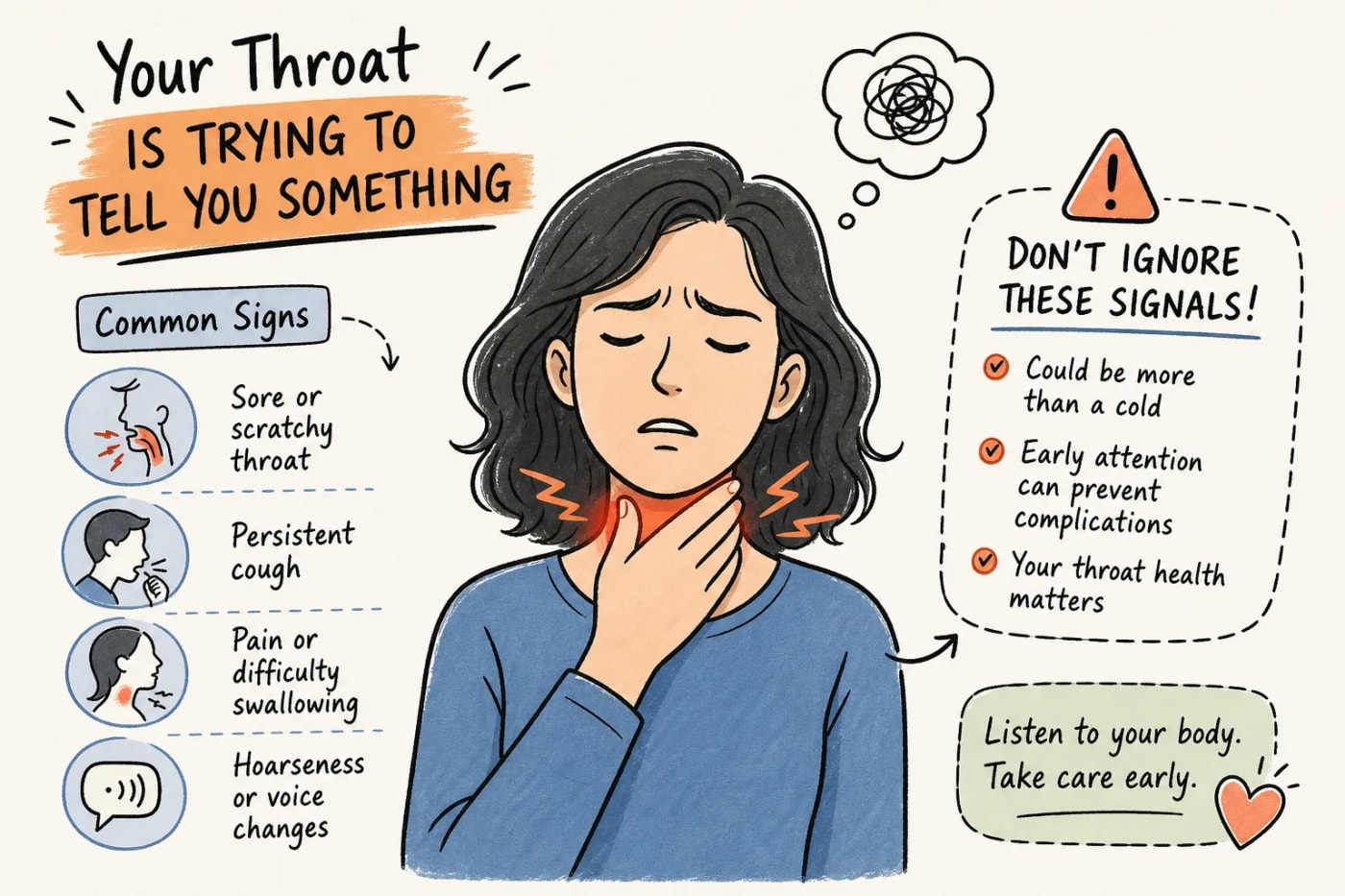
A patient once arrived after three months of what she called “a scratchy throat that just wouldn’t leave.” She had blamed Lucknow’s dust, the changing season and work stress. The examination showed recurrent tonsillitis, with inflammation severe enough to disturb her sleep. The discomfort had lasted far longer than necessary because it seemed too ordinary to investigate.
This pattern is common. People live with throat symptoms while moving between home remedies and over-the-counter medicines without a clear diagnosis. Most short-lived sore throats are harmless, but persistence, recurrence and certain associated symptoms change the situation. This guide explains what the throat does, which symptoms can be monitored and when waiting is no longer the right choice.
Why it is not “just a sore throat”
The crossroads of breathing and eating
The pharynx is a muscular tube at the back of the neck that serves both the respiratory and digestive systems. Its upper part sits behind the nose, its middle part carries air and food, and its lower part directs food towards the oesophagus while air moves towards the larynx.
Inflammation in this shared passage can disturb swallowing and breathing comfort at the same time. That is why significant pharyngitis can hurt during meals, make each breath feel scratchy and interrupt sleep.
The larynx and tonsils
The larynx, or voice box, contains the vocal cords. It produces sound and protects the airway by closing during swallowing. Inflammation or structural change in this area can affect both voice and swallowing.
The tonsils are lymphoid tissue at the entrance of the oropharynx. They help recognise pathogens entering through the mouth and nose. When they become repeatedly infected, however, the tonsils themselves may turn into a recurring source of illness.
Why throat infections keep returning
Viral versus bacterial infection
Most sore throats are viral and occur with a runny nose, cough, mild fever, tiredness or a wider cold-like illness. They commonly improve within five to seven days with supportive care. Antibiotics do not shorten a viral infection.
Strep throat is a bacterial infection caused by Group A Streptococcus. It more often causes sudden severe pain, fever, tender neck glands and white patches on the tonsils, with little cough or nasal congestion. Symptoms alone cannot always confirm the cause, so a throat swab or rapid test may be needed before antibiotics are prescribed.
Recurrent tonsillitis
Recurrent tonsillitis describes repeated episodes of swollen, painful tonsils, fever, difficulty swallowing and fatigue. When episodes are frequent, disabling and properly documented, an ENT specialist may discuss tonsillectomy rather than another cycle of antibiotics.
Commonly used thresholds include seven or more significant episodes in one year, five per year for two consecutive years, or three per year for three consecutive years. The number is only part of the decision; severity, complications, missed school or work, sleep disturbance and examination findings also matter. Read the HealthNest tonsillectomy patient FAQ for a detailed explanation.
Hoarseness and swallowing difficulty
What persistent hoarseness may indicate
Hoarseness after a cold or heavy voice use usually settles. A voice change lasting beyond two weeks without a clear explanation deserves attention, particularly when smoking, reflux or other risk factors are present. If it continues for four weeks, direct examination of the vocal cords is generally appropriate.
Possible causes include lingering laryngitis, laryngopharyngeal reflux, vocal cord nodules or polyps, vocal cord weakness and other structural changes. Laryngopharyngeal reflux may occur without heartburn. It can instead cause throat clearing, a lump sensation, excess mucus, a raw feeling or persistent voice change.
Odynophagia and dysphagia
Odynophagia means pain on swallowing. Dysphagia means difficulty swallowing. Mild pain during an obvious short-lived infection is common. Progressive pain, food sticking, coughing or choking during meals, a wet voice after eating, unexplained drooling or food coming back up should not be treated as normal variation.
These symptoms can indicate a structural problem or a risk that food or liquid is entering the airway. They need timely assessment rather than prolonged self-treatment.
Red flags that mean you should stop waiting
What helps at home
For an uncomplicated viral sore throat, supportive care is often the complete treatment:
- Drink warm fluids and maintain good hydration.
- Use honey to soothe irritation if the patient is older than one year.
- Gargle with one-quarter to one-half teaspoon of salt dissolved in about 200 to 240 ml of warm water.
- Use paracetamol or ibuprofen when suitable for the individual and taken according to medical or label guidance.
- Avoid smoke, vocal strain and other obvious irritants while the throat recovers.
A persistent scratchy sensation can also come from allergy-related postnasal drip rather than infection. Identifying the actual cause is more useful than repeatedly treating every episode as bacterial.
When antibiotics are appropriate
Antibiotics treat bacterial infections, not viral sore throats. They are most appropriate when bacterial pharyngitis is confirmed or strongly suspected after clinical assessment and, when indicated, testing. If symptoms worsen after five to seven days instead of improving, arrange a medical evaluation rather than starting an unprescribed antibiotic.
What laryngoscopy reveals
Why a standard throat examination may not be enough
A light and tongue depressor allow the visible mouth and oropharynx to be examined. The vocal cords, hypopharynx, laryngeal inlet and other deeper structures cannot be assessed adequately this way. Persistent hoarseness, globus sensation, progressive swallowing difficulty and recurring unexplained symptoms may therefore require a scope examination.
Flexible laryngoscopy at an ENT clinic
Flexible laryngoscopy uses a thin camera passed through the nose to view the vocal cords and surrounding structures in real time. The examination usually takes only a few minutes and topical anaesthesia can be used when needed. It may reveal vocal cord nodules or polyps, reflux-related changes, asymmetry, weakness, inflammation or a lesion requiring further assessment.
At HealthNest Clinic, Dr. Akansha Tewari uses laryngoscopy as part of a structured assessment alongside throat cultures, hearing assessment or allergy evaluation when clinically indicated. The clinic’s nasal and laryngeal endoscopy guide explains the procedure and preparation.
The bottom line
Most throat problems have an identifiable cause and respond well when treatment is matched to that cause. The symptoms most commonly left unaddressed for too long are recurrent tonsillitis, persistent hoarseness and progressive difficulty swallowing.
Short-lived viral infections can usually be managed with rest, fluids and symptom relief. When a problem repeats, persists or arrives with a warning sign, an ENT evaluation is the right next step. Flexible laryngoscopy, throat testing and a structured examination can replace months of uncertainty with a clear plan.

MS ENT (Gold Medalist), DNB, Fellow in Allergy, Asthma and Immunology. Dr. Tewari practices at HealthNest Clinic in Golf City, Lucknow.
View doctor profile →This article is for general education and does not replace an individual medical consultation, examination or diagnosis. Seek emergency care for severe breathing difficulty, stridor, inability to swallow saliva, rapidly worsening swelling, blue lips, confusion or another acute emergency.