Quick answers
The questions patients actually ask, answered briefly. Each one links down to the section that covers it properly — use this as the page's navigation.
Naak hamesha band rehti hai aur sar bhari-bhari lagta hai — kya ye chronic sinusitis hai?
Possibly: chronic rhinosinusitis means nasal blockage or discharge plus at least one other sinus symptom lasting twelve weeks or more. Duration alone does not settle it, though; the guidelines also ask for objective evidence of inflammation inside the nose.
What twelve weeks actually means →Will one more course of antibiotics finally clear it?
Unlikely on its own — current guidance advises against routinely prescribing antibiotics for chronic rhinosinusitis unless there is an acute flare with purulent discharge visible on examination. The persistent problem is inflammation, not a single unbeaten infection.
Why antibiotics keep failing →Is steam inhalation actually doing anything?
It can loosen secretions and ease the sensation of blockage for a while, which is why it feels useful, but it does not act on the inflammation underneath. Saline irrigation has better evidence and is one of only two treatments the guidelines actively recommend.
Where home measures stop working →I cannot smell food any more — does that mean I have nasal polyps?
Reduced or absent smell is one of the cardinal symptoms of chronic rhinosinusitis and is more often prominent when polyps are present, but it occurs without them too. Only a look inside the nose can separate the two.
Polyps, allergy and the other drivers →What will the ENT actually do at the first visit?
A detailed history, a head-and-neck examination, and usually a nasal endoscopy — a thin telescope passed along the floor of the nose to see the drainage areas that ordinary rhinoscopy cannot reach. Anything further is added only if that examination leaves a question open.
What the assessment involves →Do I have to use a nasal spray forever?
Often for a long stretch, because chronic rhinosinusitis behaves as a persistent inflammatory condition rather than a one-off infection. There is high-quality evidence that long-term intranasal corticosteroid use is effective and well tolerated in this condition.
What actually treats it →Will I end up needing surgery?
Most people will not, and the 2025 surgical guidance explicitly rejects any fixed "complete X weeks of medicines first" rule as a prerequisite. Surgery is offered when the expected benefit exceeds what continued medical treatment alone is likely to achieve.
How the surgery decision is made →Which sinus symptoms need same-day medical attention?
Go to an emergency department the same day for swelling or redness around the eye, a bulging or displaced eyeball, double vision or reduced vision, severe headache, forehead swelling, neck stiffness, confusion, signs of sepsis, or any new neurological sign. These suggest spread of infection beyond the sinuses and are not situations for a wait-and-watch approach.
Separately, arrange a prompt ENT examination — not an emergency visit, but not another repeat prescription either — for symptoms confined to one side of the nose, repeated nosebleeds, heavy crusting, or a persistent foul smell that only you can detect. These findings usually turn out to be benign, but they need to be looked at rather than treated blindly.
The full red-flag list →Twelve weeks is the line, and it is not arbitrary
Chronic rhinosinusitis is defined by duration plus objective confirmation, and the threshold both the European and American guidelines use is twelve weeks. The European Position Paper on Rhinosinusitis and Nasal Polyps (EPOS 2020) defines it in adults as two or more symptoms lasting at least twelve weeks, one of which must be either nasal blockage, obstruction or congestion, or nasal discharge running forward or down the back of the throat. The remaining symptoms that count are facial pain or pressure, and reduction or loss of smell.
That is a deliberately narrow list, and it is worth reading closely, because several complaints patients assume are "sinus" do not appear on it. Sneezing fits, itchy eyes and a streaming watery nose point more towards allergic rhinitis than sinusitis. Headache on its own, without nasal blockage or discharge, is more often a primary headache disorder than a sinus problem. Fever and severe facial pain, which most people associate with sinus trouble, are frequently absent in the chronic form — which is precisely why it goes unrecognised for years.
Why duration alone is not the diagnosis
The twelve-week rule identifies who should be assessed. It does not, by itself, confirm the condition. Both EPOS 2020 and the AAO-HNSF adult sinusitis guideline require the clinical impression to be backed by objective documentation of sinonasal inflammation — through anterior rhinoscopy, nasal endoscopy, or a CT scan. The AAO-HNSF retained that requirement unchanged in its 2025 update, which tells you how settled the point is.
This matters practically. Symptoms, endoscopic findings and imaging correlate poorly with one another in this condition, so a patient can have convincing symptoms and a near-normal nose, or a strikingly abnormal endoscopy with modest complaints. Treating a twelve-week history as sufficient grounds for a diagnosis is how people end up on years of the wrong medication for a condition they may not have.
Which raises the question most patients arrive with: if it is not a stubborn infection, why has antibiotic after antibiotic been prescribed for it?
Why the antibiotics keep not working
Chronic rhinosinusitis is primarily an inflammatory disease of the nasal and sinus lining, not a persistent bacterial infection waiting for the right drug. Bacteria, biofilms, fungi, allergens, pollutants, cigarette smoke, anatomical variation and dental infection can all contribute, but in most patients the sustaining problem is an inflamed, swollen, poorly draining mucosa — and antibiotics do nothing to that.
The guidelines have converged on this. EPOS 2020's integrated care pathway states plainly that antibiotics should be avoided at the self-care and primary-care stages of chronic rhinosinusitis. The AAO-HNSF 2025 update added a new recommendation against routinely prescribing antimicrobials for adults with chronic rhinosinusitis in the absence of an acute exacerbation, or as a mandatory prerequisite before sinus imaging or surgery. The 2025 surgical guideline goes further with a strong recommendation: do not prescribe antibacterial therapy if significant or persistent purulent discharge is absent on examination.
The exception, and why it is narrow
There is a real exception — the acute exacerbation, where a stable baseline suddenly worsens with genuinely purulent discharge. That is a defined event, established on examination, not on the patient's report that the mucus "looks yellow". Colour alone is a poor guide; yellow or green discharge accompanies ordinary viral illness routinely.
Long-term antibiotic courses, usually macrolides, are sometimes discussed for difficult cases. EPOS 2020 is candid here: because of the low quality of the evidence, the steering group is uncertain whether long-term antibiotics change patient outcomes, particularly given potential cardiovascular risks with some macrolides. That is not a prohibition, but it is a long way from routine practice, and it is a secondary-care decision rather than a repeat prescription.
None of this means the symptoms are imaginary or that nothing helps. It means the effective treatments are unglamorous — which is where most patients have already been experimenting for months on their own.
What steam, saline and home remedies actually do
Of the measures people try at home, saline irrigation is the one with genuine evidence behind it — and it is not a folk remedy but a guideline-recommended treatment. EPOS 2020 grades nasal irrigation at the highest level of evidence and advises isotonic saline or Ringer's lactate. The AAO-HNSF guideline recommends saline nasal irrigation, intranasal corticosteroids, or both for symptom relief in chronic rhinosinusitis. Two treatments, and one of them you can start yourself.
The detail matters more than most people expect:
- Isotonic, not hypertonic. EPOS 2020 specifically advises against hypertonic saline solutions because of side effects, and against adding baby shampoo. Higher salt concentration and higher temperature confer no additional benefit.
- Volume is not the deciding factor. There is insufficient evidence that large-volume irrigation outperforms a saline spray, so an expensive device is not a prerequisite.
- Technique and consistency decide the result. The care pathway puts explicit emphasis on educating patients about delivery technique and adherence — a correctly used cheap spray beats an incorrectly used expensive one.
Steam, and the things that feel like they help
Steam inhalation loosens secretions and produces a genuine, temporary sense of relief. That subjective improvement is not nothing when you are miserable, but it is symptomatic and short-lived, and it does not appear in the guideline treatment recommendations for this condition. Used alongside proper treatment it is harmless; used instead of it, it costs months.
Over-the-counter decongestant sprays deserve a firmer warning. EPOS 2020 suggests in general not to use nasal decongestants in chronic rhinosinusitis, allowing only temporary addition to a nasal steroid when the nose is very blocked. Used daily for weeks — which is exactly what happens when they are bought without advice — they can produce rebound congestion that is worse than the original complaint.
If saline and correct technique are not enough after six to twelve weeks, the pathway does not suggest trying harder at home. It suggests finding out what is actually driving the inflammation.
Polyps, allergy, and the other things behind a permanently blocked nose
Chronic rhinosinusitis is not one disease, and the subtype changes what treatment is likely to work. EPOS 2020 divides it first into primary and secondary disease, then by whether it is localised — often on one side — or diffuse, which is always bilateral. Diffuse disease is further characterised by whether the underlying inflammation is type 2 or non-type 2.
In practice, a few patterns recur often enough to be worth recognising:
| Pattern | What tends to stand out | Why it changes the plan |
|---|---|---|
| Diffuse, type 2 (often with polyps) | Loss of smell and blockage lead the picture; frequently asthma or aspirin sensitivity alongside | More likely to recur; nasal steroids, sometimes short systemic steroid courses, and in selected cases biologics |
| Diffuse, non-type 2 | Discharge and facial pain lead; less asthma, less atopy | Different medical emphasis; polyps usually absent |
| Localised or one-sided | Symptoms confined to one side, sometimes crusting or bleeding | Often does not respond to medicines and needs specialist assessment; EPOS advises referral |
| Secondary disease | Bleeding, crusting, severe pain, tissue loss, other organs involved | Points to an underlying systemic condition needing its own investigation |
Where allergy fits
Allergy is a contributing factor, not a synonym. The AAO-HNSF guideline states that clinicians may obtain allergy and immune function testing when evaluating chronic rhinosinusitis — a permissive statement rather than a routine instruction. Where allergic rhinitis is genuinely present and uncontrolled, it keeps the nasal lining swollen and drainage poor, and treating it can change how well everything else works. Skin prick testing is available at the Golf City clinic and is used when the history points that way, not as a default first step.
Both guidelines also ask clinicians to look for conditions that modify management — asthma, cystic fibrosis, an immunocompromised state, aspirin-exacerbated respiratory disease and ciliary dyskinesia among them. Dental infection is another commonly missed contributor, particularly when the disease sits in one maxillary sinus.
Sorting a patient into the right group is not something a symptom description can do, which is why the examination carries so much weight.
What a proper assessment involves
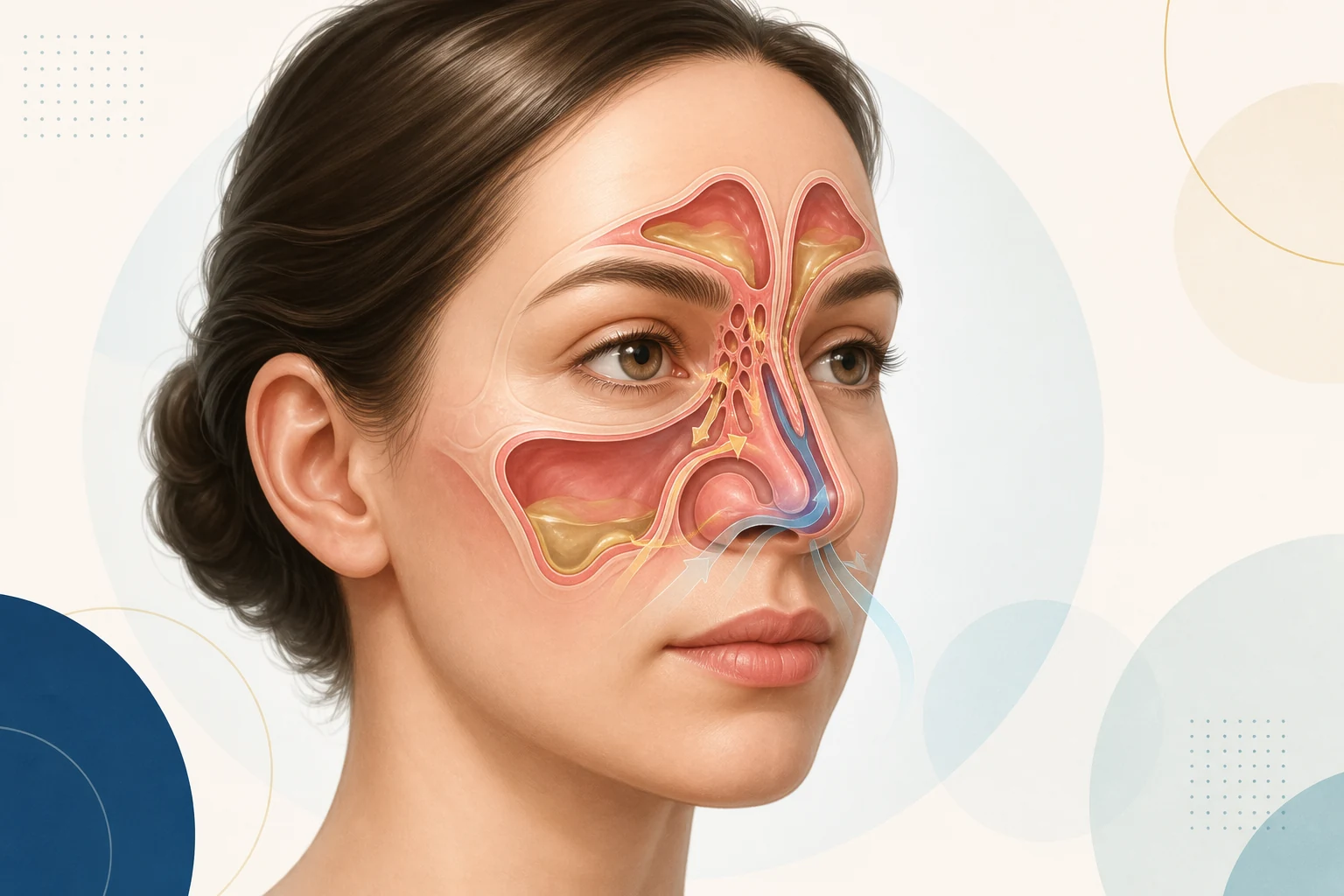
The assessment starts with the history and examination, and in most cases a nasal endoscopy settles the central question. Endoscopy provides anterior, middle and posterior views of the nasal lining, septum and turbinates, gives access to the ostiomeatal complex where the sinuses drain, allows polyps and obstruction to be identified, and permits a culture of purulent secretions if there is any. Anterior rhinoscopy — the quick look with a speculum — sees only the front of the nose and is frequently normal in a patient with significant disease further back.
Nasal endoscopy and laryngoscopy are both performed at the Golf City clinic. What the procedure feels like, and how it is done, is covered separately in the clinic's guide to nasal endoscopy.
Where a CT scan fits — and where it does not
A CT scan is not the first step. EPOS 2020 places it after nasal endoscopy in the care pathway: it is indicated when the disease is localised or unilateral, when there is suspicion of a tumour (in which case urgently), or when nasal steroid and saline used properly have not produced improvement and further work-up is needed. Plain sinus X-rays are of limited value in chronic disease and rarely change what happens next.
The 2025 surgical guideline adds one more clear indication: for an adult who is a candidate for sinus surgery, a fine-cut CT of the paranasal sinuses should be obtained for surgical planning if one is not already available. CT imaging is not performed at the Golf City clinic; when it is indicated, it is arranged at an imaging centre and the films are reviewed at the follow-up consultation.
The tests that are and are not part of this work-up
Selected patients need more. Skin prick testing is used where allergy is a plausible driver. Hearing tests — pure tone audiometry, tympanometry — belong to the assessment only if there are ear symptoms alongside, which happens often enough because a chronically blocked nose affects eustachian tube function. Blood tests and, occasionally, biopsy come into play where secondary disease such as vasculitis is suspected. These are additions to a clinical assessment, not a package, and each should have a reason attached to it.
Once the picture is clear, the treatment itself is narrower than most patients expect.
What actually treats it
For diffuse, bilateral chronic rhinosinusitis, EPOS 2020 states that local corticosteroids and saline remain the mainstay of treatment — and that is close to the whole of first-line therapy. The evidence for intranasal corticosteroids is graded at the highest level: long-term use is effective and safe, improves nasal symptoms and quality of life, reduces polyp size where polyps are present, and prevents polyp recurrence when used after sinus surgery. EPOS also records that nasal corticosteroids do not affect intraocular pressure or lens opacity, which addresses the fear that stops many patients from continuing.
Two honest qualifications belong with that. The effect size is larger in disease with polyps than without, and on one common quality-of-life score the average improvement is smaller than the threshold usually considered clinically meaningful. This is a treatment that works — not one that reliably transforms every patient.
The things that are commonly added, and what the evidence says
- Short courses of oral steroids. EPOS considers one to two courses per year a useful addition to nasal steroid treatment in partially controlled or uncontrolled disease. Systemic corticosteroids can have significant side effects, and the benefit on symptom scores does not persist at three months.
- Antihistamines. There is insufficient evidence to decide on their regular use in chronic rhinosinusitis itself. They remain appropriate for coexisting allergic rhinitis.
- Montelukast. Not recommended, except where a patient cannot tolerate nasal corticosteroids, and not advised as an add-on to them.
- Antifungal treatment. Both guidelines advise against it — EPOS advises against anti-mycotics in chronic rhinosinusitis, and the AAO-HNSF guideline states clinicians should not prescribe topical or systemic antifungal therapy.
- Probiotics, proton pump inhibitors, acupuncture. EPOS advises against all three for this condition.
- Biologics. Relevant only in a narrow group — bilateral polyps, previous surgery or unfitness for it, plus specific markers of type 2 disease. The 2025 AAO-HNSF update recommends against routine use of biologics in chronic rhinosinusitis without polyps.
Where allergy is a genuine driver and remains uncontrolled despite avoidance and optimised medication, allergen immunotherapy may be considered as specialist care for selected patients. It treats the allergic component; it is not a treatment for chronic rhinosinusitis as such.
The pathway then asks a simple question at six to twelve weeks: is there improvement? If the answer is no despite correct technique and genuine adherence, the conversation changes.
When surgery genuinely enters the conversation
Surgery is considered when the anticipated benefit exceeds what continued non-surgical management alone is likely to deliver — that is the wording of the 2025 AAO-HNSF guideline on the surgical management of chronic rhinosinusitis, and it is a deliberately individual test rather than a threshold anyone crosses at a fixed point.
The same guideline makes a change worth knowing about if you have been told to "complete the course first". It recommends that surgeons should not endorse or require a predefined, one-size-fits-all regimen or duration of medical therapy — antibiotics, steroids or antihistamines — as a prerequisite to sinus surgery. Nor should antimicrobials be a mandatory precondition for imaging or surgery. If a fixed medication marathon has been presented to you as a gate you must pass, that is not what current guidance says.
What the decision is actually based on
The guideline asks the surgeon to verify that the diagnosis genuinely meets established criteria, then to assess candidacy on symptoms, disease characteristics, quality of life and what medical or surgical treatment has already been tried. It also identifies the patients most likely to benefit from surgery and least likely to benefit from continued medical treatment alone — among them, disease with polyps, polyps with bony erosion, eosinophilic mucin, or a fungal ball.
Realistic expectations, stated plainly
The guideline devotes a specific recommendation to counselling before surgery: patients should be given realistic expectations including the potential for chronicity or relapse and the likelihood of long-term medical management afterwards, taking their subtype into account. Sinus surgery does not end the condition. It opens obstructed drainage pathways and removes diseased tissue so that medical treatment can work better — nasal corticosteroids given after endoscopic sinus surgery reduce polyp recurrence, which is a good illustration of the two working together rather than one replacing the other.
Patients are also entitled to know in advance about postoperative care — pain control, debridement visits, activity restrictions, return to work, how long follow-up continues, and the possibility of recurrence or revision surgery. Outcomes should be reassessed between three and twelve months afterwards, with both history and nasal endoscopy.
Where surgery happens. HealthNest Clinic in Golf City is an outpatient (OPD) setting: consultation, endoscopy, allergy testing and follow-up take place there. Dr. Tewari performs sinus surgery at an attached hospital, not at the Golf City rooms. If an operation is being discussed, that distinction is explained at the consultation along with where it would be carried out.
Seek urgent care for these
Chronic rhinosinusitis is rarely dangerous, but sinus infection can spread to the eye socket or the brain. EPOS 2020 lists the following as alarm symptoms requiring immediate referral. Go to an emergency department the same day if any appear:
- Swelling or redness around the eye, or a displaced or bulging eyeball
- Double vision, restricted eye movement, or reduced vision
- Severe headache, or swelling over the forehead
- Signs of sepsis, or signs of meningitis such as neck stiffness and confusion
- Any new neurological sign
The same list includes findings that need a prompt ENT examination rather than an emergency visit — and specifically not another repeat prescription: symptoms confined to one side, bleeding, crusting, and cacosmia (a persistent bad smell that only you can detect). EPOS advises that unilateral disease be referred for further diagnosis, because localised disease often does not respond to medication and may need a different approach entirely. Most such cases turn out to be benign; the point is that they are looked at.
Also worth raising promptly, though not urgently: a blocked nose alongside new hearing difficulty or persistent ear fullness, and — in a child — persistent mouth breathing, which the clinic covers in its guide to mouth breathing in children.
What this article can and cannot settle
Everything above describes how the decision is made, not what your particular decision should be. Chronic rhinosinusitis covers several distinct diseases that share a symptom list, and the subtype — which changes the treatment, the likely course and whether surgery is even relevant — is established by examination and, when indicated, imaging. No article can substitute for that, and any resource that tells you which subtype you have from a description of your symptoms is overreaching.
What is reasonable to take away: twelve weeks of a blocked nose deserves an assessment rather than another antibiotic; saline and a correctly used nasal steroid are the evidence-based backbone; and the prognosis for most patients is favourable, with treatment producing a meaningful reduction in symptom burden. If you have been managing this yourself for months, an examination is the step that is missing.
Book an ENT consultation on WhatsAppPractical questions before your visit
Logistics and edge cases that do not need a full section.
Should I bring my old prescriptions and scans?
Yes — bring every prescription you have taken for this, any previous CT films or reports, allergy test results, and operation notes if you have had nasal surgery before. A significant part of the assessment is working out what has already been tried, at what dose, and for how long. Photographs of prescriptions on a phone are fine if the originals are lost.
Is nasal endoscopy done at the same visit, or do I come back?
It is usually done during the same consultation when it is indicated, since it is an outpatient procedure that takes a few minutes and needs no preparation. There is no need to fast beforehand, and no reason to book it separately in advance.
Can I drive myself home afterwards?
Yes. Nasal endoscopy is performed with topical anaesthesia at most, not sedation, so there is no impairment afterwards and no need to bring someone with you. Some patients notice mild numbness at the back of the throat for a short while, and it is sensible to wait until that settles before eating or drinking anything hot.
Do I need to stop any medicines before allergy testing?
Antihistamines interfere with skin prick testing and usually need to be stopped for several days beforehand, but the exact interval depends on which one you take. Do not stop asthma inhalers or other regular medication on your own — ask the clinic when booking, so the visit is not wasted.
Is a sinus X-ray enough, or do I need a CT?
Plain sinus radiographs are of limited value in chronic disease and rarely change management, which is why they have largely fallen out of use for this indication. Where imaging is needed, a CT of the paranasal sinuses is the relevant study — and it is requested only after examination, not as a routine first test.
What water should I use for saline rinses?
Use previously boiled and cooled water, distilled water, or sterile water — not water straight from a tap or a stored tank. This is a genuine safety point rather than fussiness: rare but serious infections have been reported from irrigating with untreated water. Prepared isotonic sachets mixed as instructed are the simplest option.
Can children get chronic rhinosinusitis?
Yes, though the definition differs slightly — in children, persistent cough replaces loss of smell as one of the qualifying symptoms alongside blockage or discharge. Adenoid enlargement is a common contributor in this age group, and the treatment sequence is not the same as in adults, so a paediatric assessment is worth arranging rather than adapting adult advice.
References
- Fokkens WJ, Lund VJ, Hopkins C, et al. European Position Paper on Rhinosinusitis and Nasal Polyps 2020 (EPOS 2020) — executive summary. Rhinology. 2020. rhinologyjournal.com
- Payne SC, et al. Clinical Practice Guideline: Adult Sinusitis Update. Otolaryngology–Head and Neck Surgery. 2025 (AAO-HNSF).
- Shin JJ, et al. Clinical Practice Guideline: Surgical Management of Chronic Rhinosinusitis. Otolaryngology–Head and Neck Surgery. 2025 (AAO-HNSF).
- Kwon E, Sutton AE, O'Rourke MC. Chronic Sinusitis. StatPearls. Updated January 2026. NCBI Bookshelf NBK441934

View doctor profile →
This article is for general education and does not replace an individual medical consultation, examination or diagnosis. Seek urgent care for swelling or redness around the eye, visual change, severe headache, neck stiffness, confusion, sudden hearing loss, severe breathing difficulty, facial weakness, significant bleeding or rapidly worsening symptoms.