“Baar-baar chakkar aata hai, kaan mein awaaz hai aur kaan bhara-bhara sa lagta hai.”
This combination can fit Ménière's disease, especially when symptoms affect the same ear and vertigo occurs in spontaneous episodes. It can also occur with other conditions. A hearing test and careful episode history are needed before attaching the diagnosis.
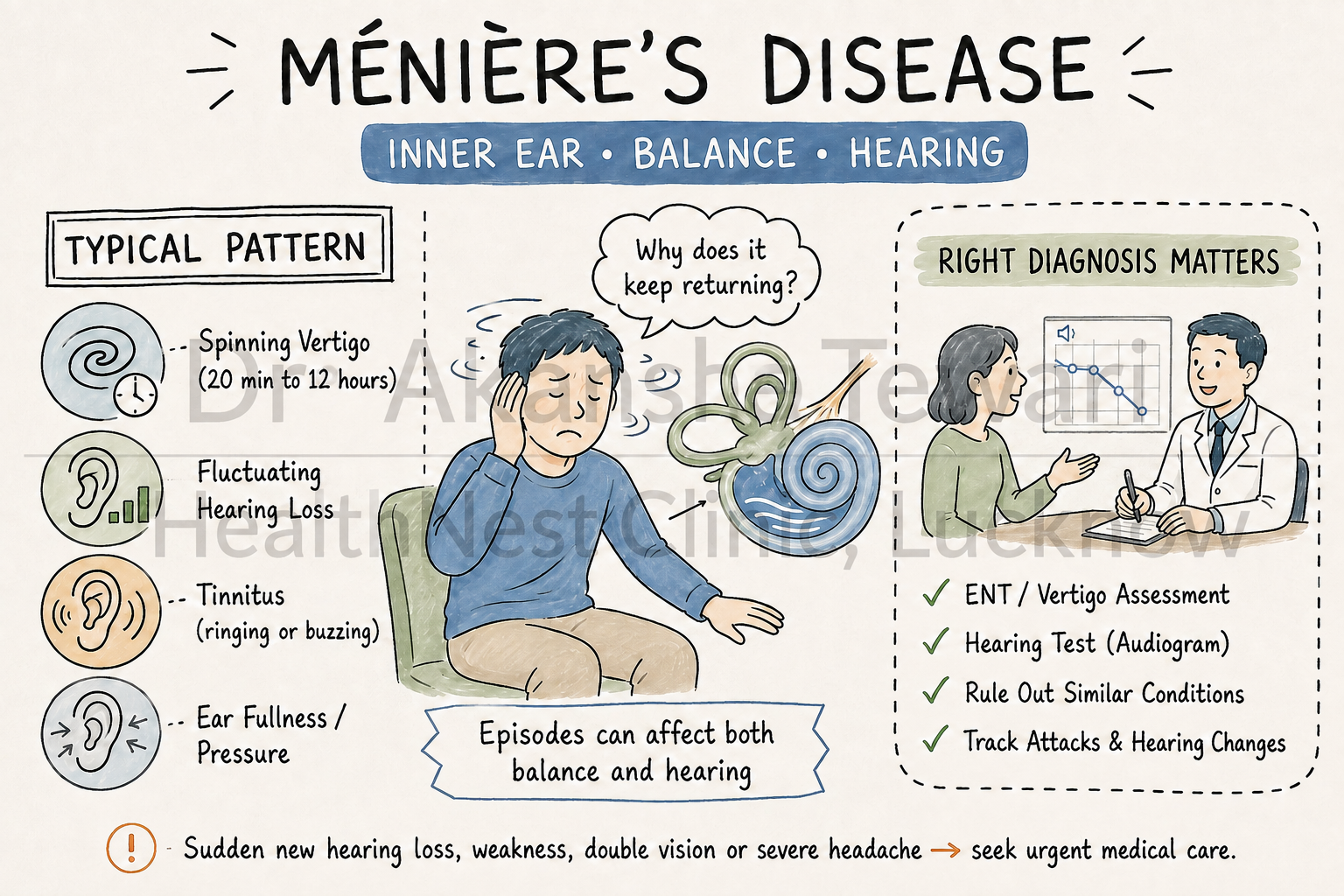
Ménière's disease is an inner-ear disorder that causes episodes of vertigo together with hearing-related symptoms. It often begins in one ear and is most common in adults aged 40 to 60, although it can occur outside that range.
The symptoms are associated with an abnormal inner-ear fluid state called endolymphatic hydrops. The underlying cause of the disease is still uncertain, so it is more accurate to describe hydrops as an associated mechanism than to assume one simple cause for every patient.
Important: Ménière's disease is not diagnosed from tinnitus, ear fullness, dizziness, VNG or an MRI alone. The diagnosis comes from the timing and recurrence of attacks, ear-specific symptoms, audiometry and exclusion of a better explanation.
The four characteristic symptoms
A definite Ménière's episode develops without a required position trigger and can cause nausea, vomiting and severe imbalance.
Hearing may improve between early attacks. Audiometry commonly shows low- to mid-frequency sensorineural loss during the diagnostic course.
The sound is typically perceived in the affected ear and may change before, during or after an attack.
The ear may feel full even when examination shows no wax or middle-ear blockage.
Not every attack contains all four symptoms at the same intensity. Some patients notice louder tinnitus, muffled hearing or increased pressure before the spinning begins. Over time, hearing recovery between episodes may become less complete.
How Ménière's disease is diagnosed
The 2015 international criteria define definite Ménière's disease using all of the following:
- Two or more spontaneous vertigo episodes, each lasting 20 minutes to 12 hours
- Low- to mid-frequency sensorineural hearing loss in the affected ear, documented by audiometry before, during or after a vertigo episode
- Fluctuating hearing loss, tinnitus or fullness in the affected ear
- No better diagnosis explaining the pattern
Probable Ménière's disease has a broader pattern: at least two episodes of vertigo or dizziness lasting 20 minutes to 24 hours, fluctuating ear symptoms and no better explanation, without the same requirement for documented hearing loss.
Audiometry is central
An audiogram is recommended when Ménière's disease is being assessed. Repeat testing can capture fluctuation and monitor longer-term hearing change.
Vestibular migraine must be considered
The AAO-HNSF guideline specifically recommends checking whether the patient meets diagnostic criteria for vestibular migraine.
MRI is selective
MRI of the internal auditory canals and posterior fossa may be considered when asymmetric sensorineural hearing loss needs evaluation for another cause. MRI does not confirm Ménière's disease by itself.
VNG is not a routine confirmation test
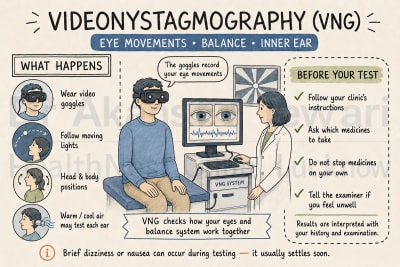
Guidelines advise against routinely ordering vestibular function testing or electrocochleography solely to establish the diagnosis. VNG may still help selectively when another vestibular disorder or balance deficit is being assessed.
An ear examination and tympanometry may help identify wax, infection, eardrum disease or middle-ear pressure problems. The investigation plan should be driven by the actual symptom pattern rather than a fixed package of tests.
Ménière's disease vs BPPV vs vestibular migraine
These conditions can all cause recurrent vertigo, and more than one can coexist. Timing, triggers, migraine features and ear-specific hearing change help separate them.
| Feature | BPPV | Vestibular migraine | Ménière's disease |
|---|---|---|---|
| Typical attack length | Usually seconds with the provoking movement | 5 minutes to 72 hours | 20 minutes to 12 hours for definite disease |
| Typical trigger | Specific head-position change | Variable; assessed with migraine history and features | Spontaneous rather than position-dependent |
| Hearing symptoms | Not part of typical BPPV | Fluctuating ear-specific hearing loss suggests another or coexisting disorder | Fluctuating hearing loss, tinnitus or pressure in the affected ear |
| Key assessment | Positional examination | Migraine and episode criteria | Episode history plus audiometry |
Brief spinning when rolling in bed is more typical of BPPV. A longer attack linked with migraine history, light or sound sensitivity, visual aura or migraine-type headache raises the possibility of vestibular migraine. A new hearing change always deserves direct assessment rather than being assigned to a familiar vertigo diagnosis.
Diet, triggers and symptom tracking
Guidelines recommend discussing dietary and lifestyle measures that may reduce symptoms, but the strength of trial evidence is important to understand. A 2023 Cochrane review found the evidence for lifestyle and dietary interventions very uncertain; it did not find placebo-controlled trials for commonly recommended salt or caffeine restriction.
Record attack start and end times, hearing changes, tinnitus, fullness, headache or light sensitivity, medicines taken and possible triggers.
Some clinicians suggest a consistent, moderate sodium intake. The target should consider blood pressure, kidney health, medicines and overall nutrition.
Alcohol, caffeine, nicotine, missed meals, dehydration, poor sleep or stress may matter to some patients. Change one factor at a time and track the result.
Regular sleep, hydration, physical activity as tolerated and smoking cessation support overall health even when they do not remove the underlying disorder.
Bring a dated symptom diary and previous audiograms to a vertigo consultation. They often clarify the pattern more than a single test performed between attacks.
Book a vertigo consultationA stepwise treatment approach
There is no single treatment that cures Ménière's disease. Management aims to make attacks safer and less disruptive, protect communication and balance, and escalate only when the disease remains active.
Manage an active attack safely
A clinician may prescribe a limited course of a vestibular suppressant for use during attacks. These medicines can cause sedation and are not recommended as routine long-term daily treatment for Ménière's vertigo.
Build an individual maintenance plan
Diuretics and/or betahistine may be offered as maintenance options under the 2020 guideline. However, Cochrane found the trial evidence for systemic medicines very uncertain, so goals, adverse effects and response should be reviewed rather than assuming benefit.
Consider specialist intratympanic treatment
Intratympanic steroid may be offered or referred for when active disease does not respond to non-invasive treatment, although trial evidence remains uncertain. Intratympanic gentamicin is a more ablative option for disease not responsive to non-ablative therapy and requires careful discussion of hearing and balance risks.
Reserve ablative surgery for selected cases
The guideline allows referral for labyrinthectomy when active disease has failed less definitive therapy and hearing in that ear is non-usable. Any destructive treatment requires careful consideration of the other ear and the patient's priorities.
Vestibular rehabilitation is recommended for chronic imbalance, not to stop an acute Ménière's attack. Persistent hearing loss should lead to counselling about hearing aids or other assistive technology.
What happens over the long term?
The course varies. Attacks may occur in clusters and then become less frequent, while hearing in the affected ear may fluctuate early and become more persistently reduced later. Repeat audiometry helps track this rather than relying only on how loud everyday sounds feel.
The second ear is not inevitably affected
A 2025 meta-analysis of 1,583 people with initially unilateral disease found a pooled conversion risk of 13%. Most patients in those longitudinal studies did not develop bilateral disease.
Conversion can occur late
Among patients who converted, the mean interval was about 8.2 years. Ten percent of observed conversions happened 20 years or more after the first-ear diagnosis, supporting long-term follow-up.
Drop attacks need a safety plan
A meta-analysis found that strict drop attacks causing a fall occurred in about 8% of hospital-based Ménière's cohorts, although definitions varied. A sudden fall, fainting or injury needs medical assessment.
Quality-of-life support matters
Hearing rehabilitation, balance therapy for chronic deficits and support for anxiety about unpredictable attacks can be as important as attack-frequency treatment.
Driving, work and daily safety
- Do not drive during vertigo or while nausea, imbalance or sedating medicine affects safe control.
- Pause work at heights, near open flames or with heavy machinery during active, unpredictable phases.
- Discuss frequent attacks or any drop attack promptly before resuming risk-sensitive duties or driving.
- Plan for attacks: sit or lie down early, keep a phone accessible and tell a trusted colleague or family member what help may be needed.
These are general safety principles. Individual driving and occupational advice depends on attack control, medicines, local rules and the nature of the work.
Go to an emergency department now if vertigo occurs with:
- Facial droop, slurred speech, one-sided weakness or numbness
- Double vision, a severe new headache, confusion or loss of consciousness
- New inability to stand or walk, especially when the pattern is unlike previous attacks
- Significant head injury, chest pain or a serious fall
- Sudden hearing loss, which needs urgent assessment through a separate time-sensitive pathway
The bottom line
Ménière's disease is a pattern-based diagnosis built from repeated spontaneous vertigo, ear-specific fluctuating symptoms and audiometry. VNG and MRI can answer selected questions but do not replace the diagnostic criteria.
Treatment should be stepped and reviewed. Lifestyle changes and commonly used medicines may be reasonable for an individual patient even though trial evidence is uncertain; more invasive options require a clear discussion of expected benefit, hearing and balance risks, and the status of the other ear.
HealthNest Clinic provides specialist vertigo assessment, audiometry and VNG when clinically indicated at Golf City, Lucknow.
Message on WhatsAppFrequently asked questions
Mujhe baar-baar chakkar aata hai, kaan mein awaaz hai aur kaan bhara-bhara sa lagta hai—kya yeh Ménière's hai?
This combination is compatible with Ménière's disease, but it does not confirm the diagnosis. An ENT clinician looks for repeated spontaneous vertigo episodes, ear-specific fluctuating symptoms and an audiogram showing the relevant sensorineural hearing-loss pattern, while excluding better explanations.
What are the main symptoms of Ménière's disease?
The typical pattern includes spontaneous episodes of vertigo, fluctuating hearing loss, tinnitus and fullness or pressure in the affected ear. For definite Ménière's disease, vertigo episodes last 20 minutes to 12 hours and the hearing loss is documented by audiometry.
Is there one test that confirms Ménière's disease?
No. Diagnosis combines the episode history, ear symptoms, audiometry and exclusion of another condition. MRI may be considered when asymmetric sensorineural hearing loss needs investigation, but imaging does not by itself confirm Ménière's disease.
How is Ménière's disease different from BPPV or vestibular migraine?
BPPV causes brief, position-triggered vertigo, usually without fluctuating hearing symptoms. Vestibular migraine episodes last five minutes to 72 hours and are linked to migraine history or features. Ménière's episodes are spontaneous, last 20 minutes to 12 hours and occur with fluctuating symptoms in the affected ear.
Is VNG required to diagnose Ménière's disease?
No. Guidelines advise against routinely ordering vestibular function testing or electrocochleography solely to establish the diagnosis. VNG can still be useful selectively when the pattern is unclear, another vestibular disorder is being considered or balance function needs assessment.
Does reducing salt treat Ménière's disease?
Some clinicians recommend a consistent, moderate sodium intake as part of an individual plan, but trial evidence for salt restriction, caffeine reduction and other lifestyle measures is very uncertain. Avoid extreme restriction and discuss dietary changes with your clinician, especially if you have another medical condition.
What treatments are available for Ménière's disease?
Treatment is stepped according to symptoms. It may include a limited course of vestibular suppressants during attacks, an individual maintenance plan, hearing support, rehabilitation for chronic imbalance and, for active disease that persists, specialist discussion of intratympanic treatment or selected surgery.
Can Ménière's disease affect the other ear?
Yes, but most patients in a 2025 longitudinal meta-analysis did not convert from unilateral to bilateral disease. The pooled conversion risk was 13 percent. Among those who converted, the mean interval was about 8.2 years, and some conversions happened much later.
Can I drive or work during Ménière's attacks?
Do not drive, work at heights or operate machinery during vertigo or while recovery affects balance and alertness. Frequent unpredictable attacks or a drop attack require an individual safety and driving discussion before resuming risk-sensitive activities.
Which vertigo symptoms need emergency care?
Seek emergency care for vertigo with facial weakness, slurred speech, one-sided weakness or numbness, double vision, a severe new headache, inability to stand or walk, loss of consciousness or significant injury. Sudden hearing loss also needs urgent assessment because it may follow a different, time-sensitive pathway.
Clinical sources
- Bárány Society and partner organisations: Diagnostic criteria for Ménière's disease
- AAO-HNSF Clinical Practice Guideline: Ménière's Disease
- NIDCD: Ménière's Disease
- Cochrane: Lifestyle and dietary interventions for Ménière's disease
- Cochrane: Systemic pharmacological interventions for Ménière's disease
- 2025 meta-analysis: Progression from unilateral to bilateral Ménière's disease
- Systematic review: Vestibular drop attacks in Ménière's disease